Tuesday, July 14, 2015

Farewell Waltz by Kundera


"It seemed to him that with every oversalted mouthful he was tasting Kamila's tears, and it was his own guilt that he was swallowing."

"For a moment his photograph had acquired a three-dimensional reality, a warmth, a weight, and then had again become an impalpable. colorless image reproduced in thousands of copies and thus all the more abstract and unreal."

"Blonde hair and black hair are the two poles of human nature. Black hair signifies virility, courage, frankness, activity, while blonde hair symbolizes femininity, tenderness, weaness, and passivity.Therefore a blonde is in fact doubly a woman."

"I'm curious about how pigments exercise their influence over the human soul," said Bertlef doubtfully."

"If black hair became a universal fashion, life in this world would clearly be better. It would be the most useful social reform ever achieved."

Now, he's just making fun...

"Why do you think they try to seduce us? Solely to defy and humiliate their fellow women. God instilled in women's hearts a hatred of other women because He wanted the human race to multiply.

Both Klima and Ruzena have groups of their own sex trying to advise them what to do in situation. Basically: what men and women do in case of an unwanted pregnancy.

"Just as love makes the beloved woman more beautiful, anxiety inspired by a woman one fears brings her smallest flaws into disproportionate relief..."

"[...] the sadness that emanated from these words of Klima's had for her a pleasant odor. She sniffed at it as if it were roast pork."

Sadness is very attractive in a vain kind of way.

"Only now having lost its charm, was the mouth suddenly what it was, a real mouth, an nonindustrial orifice through which the young woman had already taken in cubing meters of dumplings, potatoes, and soups, a mouth containing teeth pocked with fillings and saliva that was no longer an intoxicating liqueur but the cousin of a glob of spit."

Pregnancy = Power

"It thrills me so to think of giving you a child."

This is such power- overrides that he has a wife!! She isn't even in a position of saying such a thing, but just because she's pregnant- he has to pay for it. It's funny, but some women take pleasure in blaming the man for his natural "reaction". It takes two to tango.

Marriage Metaphor:
"Every time we climbed up there," Skreta went on, "Suzy tried to convince me we should get married. And I'd be so worn out by the climbing that I felt old and that there was nothing left for me but to marry. But in the end I always controlled myself, and when we came back down from the scening view my strength would come back and I'd no longer want to get married. But one day Suzy made us take a detour, and the climb took so long and I agreed to get married even before we got to the top. And now we're expecting a child, and I have to think a bit about money."

"Olga was actually one of those modern women who readily divide themselves into a person who lives life and a person who observes it."

"If Olga had been a little more foolish, she would have found herself quite pretty. But since she was an intelligent girl, she considered herself much uglier than she really was, for she was actually neither ugly nor pretty, and any man with normal aesthetic requirements would gladly spend the night with her."

"I picture my soul with a strong chin and sensual lips, but my chin is small and so is my mouth. If I'd never seen myself in a mirror and had to describe my outside appearance from what I know of the inside of me, the portrait wouldn't look at all like me! I am not at all the person I look like!"

"You need to have at least one certainty: to remain in control of your own death and o the ability to choose its time and manner. You can put up with a lot of things. You know you can get away from people whenever you want."

"It's incredible that hideous-looking individuals decide to procreate. They probably imagine that the burden of ugliness will be lighter if they share it with their descendants."

"Impelled merely by the desire to perpetuate the species, mankind will end up something itself on this small planet. But the natalist propaganda mill grinds on, and the public is moved to tears by pictures of nursing mothers and infants making faces. It disgusts me. It chills me to think that, along with millions of other enthusiasts, I could be bending over a cradle with a silly smile." 

"Something that always utterly disgusts me about mankind is seeing how its cruelty, its baseness, and its stupidity manage to wear the lyrical mask. She sends you to your death, and she experiences it as a romantic feat of wounded love. And you mount the scaffold because of an ordinary narrow-minded woman, feeling that you are playing a role in a tragedy Shakespeare wrote for you." 

"They wished to take revenge on and torpedo with the repulsiveness of their bodies the glory of female beauty, for they knew that bodies, whether beautiful or ugly, are ultimately all the same and that the ugly overshadow the beautiful as they whisper in men's ears: Look, this is the truth of the body that bewitches you! Look, this big flabby tit is the same thing as the breast you so madly adore." 

"When he is more mature he will find out that things are transient, and he will become aware that beyond one woman's horizon there opens up a horizon of yet more women." 

"Your dirt too, sir, is vanity, and your vanity is dirty." 

A reference to a toothache (Notes from the Underground):
"He cannot sit down. Jealousy is like a raging toothache. One cannot do anything when one is jealous, not even sit down. One can only come and go. Back and forth." 

"[...] it was because of her that their marriage was menaced by a bomb deposited in another woman's belly, by a charge timed to blow everything up in seven months." 

Everyone is death with anxiety- with things that mean the world to them- and in a second don't matter. Like for Ruzena and Jakab- they eventually become indifferent to their world/anxieties.

Kima and Mrs. Klima have a very sick love. They know everything about each other and the relationship is seeping with jealousy and regret, They have lost the connection long ago but don't want to admit it.


Further CONNECTIONS with Dostoevsky:
References Crime and Punishment

"Yes, there was something that brought him close to Raskolnikov: the pointlessness of the murder, its theoretical nature." 

and

"Jakub was amazed that his act was so light, so weightless, amazed that it did not overwhelm him. And he wondered if this lightness was not more terrifying than the Russian character's hysterical feelings." 

"'The police don't have much influence over the infernal powers,' the inspector said."

---------------------------------------------------------------------------------------------------------------------

He spun around this controversial topic very elegantly. I really liked each person's perspective/incentives towards abortion and pregnancy. Klima had to remove this from his wife's knowledge so wanted an abortion. Ruzena was a "stupid slut" apparently with a "good heart" and used her pregnancy as a way of getting money/fame. The poor girl was very CLOSE to thinking though!  Mrs. Klima is a typical housewife suffering from paranoia and yet beautiful. The Doctor helped Klima because he wanted fame.

Interesting story- of course I take it more of a farce than discussing the topic of abortion seriously. I guess it shows what happens to certain individuals when such a situation presents itself.

Pub: Harper Perennial


Tuesday, June 30, 2015

Slaughter-House-Five by Vonnegut

"And what do the birds say? All there is to say about a massacre, things like "Poo-tee-weet?"

"But she did look back, and I love her for that, because it was so human."

"He still very much alive in the past, so it is very silly for people to cry at his funeral. All moments, past, present, and future, always have existed, always will exist."

"It is just an illusion we have here on Earth that one moment follows another one, like beads on a string, and that once a moment is gone it is gone forever."

"Human beings in there took turns standing or lying down. The legs of those who stood were like fence posts driven into a warm, squirming, farting, sighing earth. The queer earth was a mosaic of sleepers who nestled like spoons."

"He said that everything there was to know about life was in The Brothers Karamazov, by Feodor Dostoevsky. 'But that isn't enough any more,' said Rosewater."

"The flaw in the Christ stories, said the visitor from outer space, was that Christ, who didn't look like much, was actually the Son of the Most Powerful Being in the Universe. Readers understood that, so, when they came to the crucifixion, they naturally thought, and Rosewater read out loud again:
Oh, boy- they sure picked the wrong guy to lynch that time!
And that thought had a brother: 'There are right people to lynch.' Who? People not well connected. So it goes."

God is the best connection to have!

------------------------------------------------------------------------------------------------------------

I'm glad I first read "A Man Without a Country" first- because it really helps me understand this book. He talks about how he tried to write the book and how he didn't know where to start. He had seen so much and he wanted to do it justice.
"Why had it taken me twenty-three years to write about what I had experienced in Dresden? We all came home with stories, and we all wanted to cash in, one way or another. And what Mary O'Hare was saying, in effect was, 'Why don't you tell the truth for a change?'"
And I guess that's what the book turned out to be- about some idiot guy who stumbles into this situation and doesn't know what to do with it. Ridiculousness.

I enjoyed the concept of time in this book- and how we just get stuck in this chronological way of life. We can't see beyond it most of the time.

A Man Without a Country by Kurt Vonnegut

My very good friend suggested this book to me while in Russia- having never heard of Kurt Vonnegut. They pronounce it as Vohn-e-gut. I had no idea that he is such a famous American writer.

"Some of the crazymaking games going on today are love and hate, liberalism and conservatism, automobiles and credit cards, golf, and girls' basketball." 

"Whenever I swim in an ocean, I feel as though I am swimming in chicken soup." 

"He was simply noticing, and surely not condemning, the fact that religion could also be comforting to those in economic or social distress." 

"Don't spoil the party, but here's the truth: We have squandered our planet's resources, including air and water, as though there were no tomorrow, so now there isn't going to be one." 

"What you can become is the miracle you were born to be through the work you do."

"How beautiful it is to get up and go out and do something. We are here on Earth to fart around. Don't let anybody tell you any different."

"[...] but the priceless gift that African Americans gave the whole world when they were still in slavery was a gift so great that it is now almost the only reason many foreigners still like us at least a little bit."  

"I know of very few people who are dreaming of a world for their grandchildren." 

"What you can become is the miracle you were born to be through the work that you do." 

"What has allowed so many PPs [psychopathic personalities] to rise so high in corportations, and now in government, is that they are so decisive." 

"By saints I meant people who behaved decently in a strikingly indecent society." 

"God would have to be an atheist, because the excrement has hit the air-conditioning big time, big time." 

"I'm startled that I became a writer. I don't think I can control my life or my writing." 

"And I urge you to please notice when you are happy, and exclaim or murmur or think at some point, If this isn't nice, I don't know what is." 


Saul Steinberg
------------------------------------------------------------------------------------------------------------
Jesus Christ was an anarchist.


--
Pub by Seven Stories Press 

Monday, April 13, 2015

The Master of Petersburg by Coetzee

"Her tongue like a bird fluttering in her mouth: soft feathers, soft wing-beats."

"If we do not forget, they say, the world will soon be nothing but a huge library."

"It is from knowing that he is dead that he wants to protect his son. As long as I live, he thinks, let me be the one who knows! By whatever act of will it takes, let me be the thinking animal plunging through the air."

Thinking animal- I like that.

"In his fingers a needle is a curiosity, an arrow from Lilliput." 

"Forever I look back. Forever I am absorbed in your gaze. A field of crystal points, dancing, winking, and I one of them. Stars in the sky, and fires on the plain answering them. Two realms signalling to each other."

"Rather, he feels like a leaf or a seed in the grip of a headlong force, a winged seed drawn up into the highest windstream, carried dizzily above the oceans."

Marvelous. Coetzee connects the process of sex to reaching his dead son. 

"Nothing in the pressure of her body answers to him. Disgrace, he thinks: this is how one enters disgrace."

Maybe that is the secret to his other book.

"For that is surely what a woman wants: to be courted, wooed, persuaded, won! Even when she surrenders, she wants to give herself up not frankly but in a delicious haze of confusion, resisting yet unresisting. Falling, but never an irrevocable falling. No: to fall and then come back from the fall new, remade, virginal, ready to be wooed again and to fall again. A playing with death, a play of resurrection."

"'Why are we given old age, brothers? So that we can grow small again, small enough to crawl through the eye of a needle.'"

"A horse does not understand that it has been born into the world to pull carts. It thinks it is here to be beaten. It thinks of a cart as a huge object it is tied to so that it cannot run away while it is being beaten.'"

"Is such a woman marked by abandon, an abandon that does not care where it leads, to pleasure or to pain, that uses the sensual body only as a vehicle, and only because we cannot live disembodied?"

"Not the People's Vengeance but the Vengeance of the Sons: is that what underlies revolution – fathers envying their sons their women, sons scheming to rob their fathers' cashboxes?"

--------------------------------------------------------------------------------------------------------------
He writes beautifully. I actually read this while living in St. Petersburg, Russia. He knows the city pretty well- I wonder if he lived here for awhile?
I like that he wrote about Dostoevsky. and from such an interesting angle.

Pub- pdf 

Disgraced by J.M. Coetzee

"Yet the old men whose company he seems to be on the point of joining, the tramps and drifters with their stained raincoats and cracked false teeth and hairy earholes - all of them were once upon a time children of God, with straight limbs and clear eyes. Can they be blamed for clinging to the last to their place at the sweet banquet of the senses?"

He doesn't see her for who she is because he doesn't have an interest in her but the idea of her and what she inspires in him.

3 different kinds of disgrace: his own resignation, his daughter's rape, and the dogs that are killed because no one wants them. He cares about the disgrace of others, he is very attentive to it. "But the dogs are dead; and what do dogs know of honour and dishonour anyway? For himself, then. For his idea of the world, a world in which men do not use shovels to beat corpses into a more convenient shape for processing." It gives him meaning in life, a purpose, to save the dogs' honor. He also compares his daughter to the dogs, him needing to be a guide in her life.

In a way it's unfair- what Bev thinks of David. Expecting him to "do his duty" just because he has heard things about him. Thinking a man will not say "no" which is true most of the time.

"He thinks of himself as obscure and growing obscurer. A figure from the margins of history."

"But I say to myself, we are all sorry when we are found out. Then we are very sorry. The question is not, are we sorry? The question is, what lesson have we learned? The question is, what are we going to do now that we are sorry?"

"[...] trying to accept disgrace as my state of being."

He asks himself whether he will be forgiven for betraying the dogs. From whom is he asking forgiveness?? Is it God? Is it himself?

"That is how it must be from here on: Teresa giving voice to her lover, and he, the man in the ransacked house, giving voice to Teresa. The halt helping the lame, for want of better."

Stepping over time.

"Teresa now sits staring out over the marshes toward the gates of hell, cradling the mandolin on which she accompanies herself in her lyric flights [...]" 

This would make a great painting.

"That is what Soraya and the others were for: to suck the complex proteins out of his blood like snake-venom, leaving him clear-headed and dry."

"By Melanie, by the girl in Touws River; by Rosalind, Bev Shaw, Soraya: by each of them he was enriched, and by the others too, even the least of them, even the failures. Like a flower blooming in his breast, his heart floods with thankfulness."

"'Yes, I agree, it is humiliating. But perhaps that is a good point to start from again. Perhaps that is what I must learn to accept. To start at ground level. With nothing. Not with nothing but. With nothing. No cards, no weapons, no property, no rights, no dignity.' 
'Like a dog.' 
'Yes, like a dog.''

Clever how he ties it back to the dog motif.

"How can he ever explain, to them, to their parents, to D Village, what Teresa and her lover have done to deserve being brought back to this world?"

------------------------------------------------------------------------------------------------------------------
Dogs symbolize disgrace. He chose to give up his disgrace maybe, in the end.
I like this character, but he doesn't have much depth. He is very confused most of the time, but in an "obscure" way. That's right he is obscure- nothing really defined. I don't understand what he fought FOR exactly. He keeps saying that it was his "principle" to plead guilty but not grovel in front of his accusers and beg for his life back. Maybe it was pride, it certainly wasn't love. He just picked her up one day and had his way with her, and mostly without her consent. That's the creepy part. I guess it was probably her youth that got to him. He was losing himself, becoming older. He doesn't seem to have much meaning in life, doesn't like his job, and has occasional sex with whores.
Then why did he take it so hard? When he lost his job- one which he didn't like? When he became a laughing-stock? What was it exactly that he lost?
That's what's puzzling.
The fact is- I don't think he learned anything from this experience. He still experienced desire when he looked at her little sister, he still went to the theater to see her. If he wasn't chased away by the boyfriend, what would he have done? Gone after her to the dressing room? I wouldn't put it past him.
He likes to have things his own way, incapable of understanding the decisions of his daughter.
He has attachment issues, picking up women and then discarding them.
Yes obscure. For that- I like Coetzee because he showed this ambiguity perfectly. One can't put one's finger on what exactly this character is. Not maybe because he doesn't have depth, but it's not shown, because maybe the character himself doesn't even know.
His daughter was raped and decided to keep the child. That's the worst kind of disgrace, especially with the little boy living on the same land. And yet- she lived with it. She didn't give up, while David is complaining and moaning about his little affair. Mr. Isaac was right- he's sorry because he was found out. Actually he's sorry because she didn't return the same passion he had for her. She betrayed him in a way, and that is his disgrace. Doing the act itself, no regrets whatsoever, justifying it by saying it's a "passion". Anyway I don't think he did something wrong, good for him, good for her- although she wasn't that into it.

He is unwanted just like the dogs which are put down. No one wants him, not his daughter, not his lover, not the school. He is not needed by this world, and I guess that is a hard thing to live with. Which is why he goes back to the dead and finds comfort with them, with the concept of Immortality. Teresa was also discarded by Byron (not loved). He finds comfort in that.

Interesting book, too plot-based, not the style I usually read. But I like the way he doesn't really tie anything together, and how undefined it is.

---
Pub- pdf (here)


Wednesday, March 18, 2015

Immortality by Kundera

"There is a certain part of all of us that lives outside of time. Perhaps we become aware of our age only at exceptional moments and most of the time we are ageless."

"That finding leads us to a shocking conclusion: a gesture is more individual than an individual. [...] it is gestures that use us as their instruments, as their bearers and incarnations."

Gestures are more unique and rare than humans.

"Everything else is without importance, from the Creator's point of view, and is only a play of permutations and combinations within a general program, which is not a prophetic anticipation of the future but merely sets the limits of possibilities within which all power of decision has been left to chance."

"When we are thrust out into the world just as we are, we first have to identify with that particular throw of the dice, with that accident organized by the divine computer: to get over our surprise that precisely this (what we see facing us in the mirror) is our self. Without the faith that our face expresses our self, without that basic illusion, that archillusion, we cannot live, or at least we cannot take life seriously. And it isn't enough for us to identify with our selves, it is necessary to do so passionately, to the point of life and death. Because only in this way can we regard ourselves not merely as a variant of a human prototype but as a being with its own irreplaceable essence." 

"She would go out into the street holding the flower before her eyes, staring at it tenaciously so as to see only that single beautiful blue point, to see it as the last thing she wanted to preserve for herself from a world she had ceased to love."


"Suddenly frightened by her hatred, she said to herself: the world is at some sort of border; if it is crossed, everything will turn to madness: people will walk the streets holding forget-me-nots or kill one another on sight"

As if those two were the same thing...

"Hate traps us by binding us too tightly to our adversary. This is the obscenity of war: the
intimacy of mutually shed blood, the lascivious proximity of two soldiers who, eye to eye, bayonet each other."

"The purpose of the poetry is not to try to dazzle us with an astonishing thought, but to make one moment of existence unforgettable and worthy of unbearable nostalgia."

"That instant when Agnes suddenly, without preparation, lifted her arm in a flowing, easy motion was miraculous. How was it possible that in a single fraction of a second, and for the very first time, she discovered a motion of the arm and body so perfect and polished that it resembled a finished work of art?"

A gesture becoming a masterpiece in itself.

"It was as if two distant times had suddenly met in a single second and two different women in a single gesture."

"[...] things exist in their essence even before they are materially realized and named."

Fully believe that. 


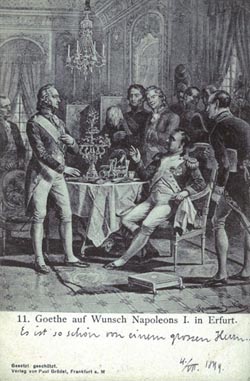
Bettina and Goethe: "[...] but I soon understood that what you wanted to show me was not a drawing but a pistol that you are holding, aiming far into my immortality." She wanted to follow him into immortality.

"And I realized that my Faust didn't interest them at all and that the show they wished to see was not the puppets I was leading around the stage, but me myself! Not Faust, but Goethe!"

When it comes to revering authors- we must admire their work not their personal lives.

"There are two methods for cultivating the uniqueness of the self: the method of addition and the method of subtraction. "
Adding: " But the matter becomes less idyllic if a person decides to add love for communism, for the homeland, for Mussolini, for Catholicism or atheism, for fascism or antifascism"

"And since for contemporary man reality is a continent visited less and less often and, besides, justifiably disliked, the findings of polls have be- some a kind of higher reality, or to put it differently: they have become the truth."

Please tell us the REALITY.

"Things will lose ninety percent of their meaning and will become light. In such a weightless environment fanaticism will disappear. War will become impossible."

"Strange: she was up to her ears in love with him and yet she had no interest in him. I could even say: she was up to her ears in love with him and precisely for that reason she had no interest in him.  ([...] The emotion of love gives all of us a misleading illusion of knowing the other. "
We can see a parallel between Laura and Bettina: 
"[...] the cause and object of her love was not Goethe, but love."

American culture:
" As soon as feelings are seen as a value, everyone wants to feel; and because we all like to pride ourselves on our values, we have a tendency to show off our feelings."

"It is part of the definition of feeling that it is born in us without our will, often against our will. As soon as we want to feel {decide to feel, just as Don Quixote decided to love Dulcinea), feeling is no longer feeling but an imitation of feeling, a show of feeling. This is commonly called hysteria."

"Nineteenth-century writers often ended their novels with marriage. This was not because they wanted to save the love story from marital boredom. No, they wanted to save it from intercourse!"

Ahh-- now I understand Jane Austen.... :)

The Russian soul- "The modern age, based on Cartesian critical thought, only penetrated there after a lag of some one or two hundred years. Homo sentimentalis thus failed to find there a sufficient counterweight and became his own hyperbole commonly known as the Slavic soul."
Everything is forgiven if it's done in the name of love. France has ceased to feel.

"The basis of the self is not thought but suffering, which is the most fundamental of all feelings."

"Beauty, more than ugliness, reveals the nonindividuality, the impersonality of a face."

"And that's life: it does not resemble a picaresque novel in which from one chapter to the next the hero is continually being surprised by new events that have no common denominator. It resembles a composition that musicians call a theme with variations."

About the horoscope. How true.

"Your life will always be built from the same materials, the same bricks, the same problems, and what will seem to you at first "a new life" will soon turn out to be just a variation of your old existence."

"An individual does not receive a share of indecent fantasy from a lover by means of Telephone but by means of this impersonal (or superpersonal or sub-personal) stream. To say that this river that runs through us is impersonal means that it does not belong to us but to him who created us and made it flow within us; in other words, that it belongs to God or even that it is God or one of his incarnations."

That's saying something. Sexuality is a spiritual creation.

"That's why love, in order to prove itself true, wishes to escape the sensible, wishes to reject moderation, doesn't wish to seem probable; longs to change into the delires actifs de la passion (let's not forget Eluard!), in other words, wishes to be mad! "

"[...] no episode is a priori condemned to remain an episode forever, for every event, no matter how trivial, conceals within itself the possibility of sooner or later becoming the cause of other events and thus changing into a story or an adventure." 

----------------------------------------------------------------------------------
So many ideas iin this book! Really I haven't even begun to process all of them. I must read it again and again... Throughout my entire lifespan.


Sunday, January 18, 2015

The Collector by John Fowles

"It’s some crude animal thing I was born without. (And I’m glad I was, if more people were like me, in my opinion, the world would be better.)"

"That was the day I first gave myself the dream that came true."

I like the way he writes this "gave myself" as if he is allowing himself to dream, as if it was a bad thing, or too much of it would be destructive.

"It stopped being a dream, it began to be what I pretended was really going to happen (of course, I thought it was only pretending)"

You can make yourself believe anything if you try hard enough.

"Guest"- i love that. He makes it sound so normal.

"It finally ten days later happened as it sometimes does with butterflies. I mean you go to a place where you know you may see something rare and you don’t, but the next time not looking for it you see it on a flower right in front of you, handed to you on a plate, as they say."

"I took a risk, perhaps I wanted to give fate a chance to stop me." 

It's nice of him to invent a story that he's following someone's orders, because it doesn't seem AS creepy.

Ah now I see. Because he's a collector he's used to catching things, beautiful specimens: "It was like not having a net and catching a specimen you wanted in your first and second fingers (I was always very clever at that), coming up slowly behind and you had it, but you had to nip the thorax, and it would be quivering there. "

"You’re like a miser, you hoard up all the beauty in these drawers."

"There were just all those evenings we sat together and it doesn’t seem possible that it will never be again. It was like we were the only two people in the world."

 “What I fear in you is something you don’t know is in you.” 

"It was no good, she had killed all the romance, she had made herself like any other woman, I didn’t respect her any more, there was nothing left to respect."

I don't know whether I like this G.P. character. He seems like a selfish bastard- and very sexist. What is it with men that want women to be "a certain way" and to "be themselves" as if they have the right to expect things, and if they don't get them, then they blame the woman. Just like Ferdinand- he puts impossible expectations on her, and then becomes angry when she cannot fulfill them. This whole "female nobility" business. It's stupid and I don't believe in it. These type of men just want women to be their savior, a muse- to exist as a decoration for their own existence.
I think Fowles understands my frustration:
"He said, men are vile. 
I said, the vilest thing about them is that they can say that with a smile on their faces." 
 As if saying that justifies them.

At first I didn't like the style of the book, with both characters narrating... but I like it now. He set up a general "events" and adds the details with Miranda's diary. As if filling the spaces in. Because among all the facts, she also has a whole different world/experience going on.

I like her- at first I also didn't. But she's more than meets the eye- she's more than just a pretty girl. She's not extremely smart, but she has a great sense of intuition.  She's very deep and she's attracted to sadness.

"I felt sorry for Caliban this evening. He will suffer when I am gone. There will be nothing left. He’ll be alone with all his sex neurosis and his class neurosis and his uselessness and his emptiness. He’s asked for it. I’m not really sorry. But I’m not absolutely unsorry." 

"I am one in a row of specimens. It’s when I try to flutter out of line that he hates me. I’m meant to be dead, pinned, always the same, always beautiful. He knows that part of my beauty is being alive, but it’s the dead me he wants. He wants me living-but-dead."

What keeps her going is that she thinks she's special: "Why should we tolerate their beastly Calibanity? Why should every vital and creative and good person be martyred by the great universal stodge around? In this situation I’m a representative." Because I would have killed myself by now.

What makes her so special?? She's beautiful but smart (which is rare) but anyone becomes a "specimen" if they would be trapped in a room...

"Then there’s his weakness. The feeling that he would probably betray me. And I’ve always thought of marriage as a sort of young adventure, two people of the same age setting out together, discovering together, growing together. But I would have nothing to tell him, nothing to show him. All the helping would be on his side." 

"He’s not human; he’s an empty space disguised as a human." 

" Deep down in him, side by side with the beastliness, the sourness, there is a tremendous innocence. It rules him. He must protect it." 


"A strange thought: I would not want this not to have happened. Because if I escape I shall be a completely different and I think better person. Because if I don’t escape, if something dreadful happened, I shall still know that the person I was and would have stayed if this hadn’t happened was not the person I now want to be." 

That's insane!

"I’ve not only never felt like this before, I never imagined it possible. More than hatred, more than despair. You can’t hate what you cannot touch, I can’t even feel what most people think of as despair. It’s beyond despair. It’s as if I can’t feel any more. I see, but I can’t feel."

It's so weird how Ferdinand uses "well" when he's describing her death. Like "well you know, what can you do"... as if she was a hamster...

"I found her diary which shows she never loved me, she only thought of herself and the other man all the time." 

---------------------------------------------------------------------------------------------------
Wow! No I am shocked out of my mind! No!! What a horrible man. It's so sad because Miranda actually wanted to "cure" him and find out what he actually IS. What he's made up of- and she had all of these horrible mood changes- but she still came to pity him in the end. Even though he wanted to play "creator". The worst thing is that he loved her from afar. He was never "involved" with her- not sexually, but wanted to get to know her. He curiously looked at her from behind the glass- everything she said/did was beautiful. Except her wanting to be independent from him. She was exactly what she said, a "fey".
She debased herself completely- went against all her principles just so she can be free. She kept on wanting to live until the end.

In the end I do like her. She was noble, she was trapped but her goodness came out in the end. She even dreamed about defending him in court.

Great author. Very very skilled. I mean we delved into the world of a kidnapper-kidnapee... and he is so sympathetic to the whole situation, trying to give both their "justifications" and even showing this creepy/absurd relationship they had. But in the end, I think he despises this Ferdinand, because although he makes it sound like an "idea" or a "dream" we can see how realistically/easily it can come true...


It's creepy how real this movie becomes- SO NOT OKAY.