
Showing posts with label Turgenev. Show all posts

Thursday, March 11, 2010

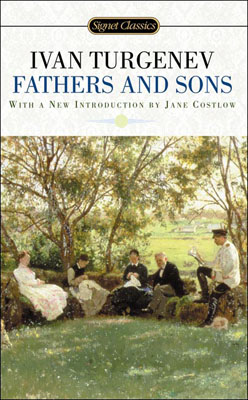
Fathers and Sons by Turgenev


"Here, in the cool shade, she read and worked, or surrendered herself to that sensation of perfect peace which we are all presumably familiar and whose charm lies in a barely conscious and silent observation of the sweeping wave of life that for ever rolls all around us as well as within us."

"It was a glorious, fresh morning; tiny mottled clouds stood out, like fleecy lambs, in the transparent azure of the sky: fine beads of dew lay sprinkled over the leaves and grasses, glittering like silver among the cobwebs; the rosy tints of dawn still seemed to cling to the moist dark earth; from the depths of the sky larks showered their songs."

"The magic world, which he was just entering and which was looming out from the misty waves of the past, wavered- and vanished."

Like Pushkin, Turgenev is a genius in describing the vague...

"However passionate, sinful and rebellious the heart wrapped away in that grave, the flowers that blossom there peep out at us tranquilly with innocent eyes: they speak to us not only of all embracing peace, of the vast repose of 'indifferent' nature, they tell us also of everlasting reconciliation and life without end..."

Oh what mysteries nature holds! How much it knows, and how much it holds inside itself! In the end, nature will tell us who we really are- in the most innocent and indifferent way...
---------------------------------------------------------------------------------------------

What a beautiful lesson! No matter what we say, what we thing that we are, we are shown by nature and God, the constants, tat we re just foolish insignifcant cretures and to have all thse beliefs that make up our lvies is just foolish. We must turn and give in to the simplicity of nature. Everytihng isn't meaningless, for then life would be meaningless in itself! No, what nature tells us is that everything has a place, a destined place, and we must give in and not fight it, for we would only torment ourselves in the end...

And also I'm sometimes reminded of this book- the difference between the new "youth" and the ones who have lived through it all. There will always be the progressives in the youth, and the traditional in the old. It has been played over and over, generation after generation. How beautifully the father said when he admitted that he didn't know anything. But do the elderly cease to count when the young take over? Weren't their experiences also meaningful and helpful to mankind? I read somewhere that this age is only there because of the previous one- it builds upon what is already there. So the old are as important as the new, one reminds us what we were and the other of what we will be.

Wednesday, December 23, 2009

A Sportman's Notebook by Turgenev


"...night reigned in all the majesty of its empire; the moist freshness of late evening has given place to the dry warmth of midnight, which would lie for some while yet, in a soft veil, over the sleeping fields."

I love how he refers to the "warmth of midnight"- gives this feeling of tranquility and piece.

"It is a strangely enjoyable occupation to lie on one's back in the forest and look upwards. You seem to be looking onto a bottomless sea, extending far and wide beneath you; the trees seem not to rise from the ground, but, like the roots of huge plants, to drop perpendicularly down into those glass-clear waves, and the leaves on the trees are now translucent as emeralds, now opaque with a goldfish, almost blackish, green. Somewhere far, far away, at the end of its slender twig, a single leaf stands motionless against a blue path of pellucid sky, and beside it another one sways with a movement like the play of a fish on a line, a movement that seems spontaneous and not produced by the wind."


Most beautiful description he has ever written. I have never before come upon this concept- that the sky is the ocean, as if everything is backwards...and the trees are in the waters... The leaf has a mind of its own, as if it really was "a fish on a line". That is why I like the Russians the best. Marvelous

"...it was as if some immense forces were lying, sullenly inactive, within him, as if they knew that, once aroused, once let loose, they must destroy themselves and everything they touched."

Such extreme violence can be hidden in the dormant...Makes us wonder how truly "peaceful" we really are...

"The leaves were whispering faintly over my head: you could have told the time of the year from their whisper alone."

-----------------------------------------------------------------------------------
In this book, Turgenev was closest to nature, his talent is most evident. He had beautiful descriptions in this book- about nature and Russian classic characters- like the peasant and the landlord. Seems very real. I can't believe he wrote this in Paris.

A Month in the Country by Turgenev

"What's the point of writing if you weren't born with the talent for it? -people will only laugh at you. And apart from that- it's very strange, perhaps you can explain it to me- even an otherwise clever man seems to become completely stupid when he takes a pen in his hand. No, it's no use writing- let's be thankful we can understand what's being written."

This talent cannot be "developed" like so many workshops try to make one do. One is born with it.

"...all love- whether it be happy or unhappy- it's sheer misery if you surrender completely to it... Just wait a little, and perhaps you will learn how these tender little hands can torture you, and with what loving care they tear your heart to pieces...wait a little, and you will find out what pangs of hatred lurk beneath the most passionate love!...Wait a bit, and you will learn what it is to belong to a woman, what it means to be enslaved and infected- and how degrading, how wearying that slavery is! And in the end you will learn what trivialities are brought for so dear a price..."

This side of "love" is rarely talked about. How so much evil can be found in it.
-----------------------------------------------------------------------------------

Again, reminds me of Anna Karenina. But not just adultery...anything, even human love, can be too much if one delves too deep into it. As an obsession. It can become "sheer misery." I wonder if man these days are still enslaved as in the older times, when men thirsted fpr women- but were forbidden (or maybe an obstacle) by society. maybe it provided more of a challenge....one had to go around the system. Are women so controlling nowadays? I don't see many cases....since everything is so liberal...

And about the main woman, Natalya Petrovna. Even though she has a girlish and immature air, she is extremely selfish. All for her own gain, even if she is sincere. This selfishness is dangerous, especially when she doesn't realize it in herself; because she doesn't know what she wants, and may even feel guilty about it.

After reading the analysis, it turns out that Natalya was dominating because her father had scared her in childhood. What was more interesting though, is that Rakitin (her lover) has ceased to be a man. When a woman dominates a man, he ceases to be one, because the main function of a man is to be dominant at least in some way- if he loses that, he loses his function...and becomes a mere body walking about. So those traditional roles are somewhat true, to a certain extent. If roles switch, nature itself is thrown off balance- which ends up being "sheer misery" and chaos.
--
Pub by Chandler Co

Wednesday, December 16, 2009

Virgin Soil by Turgenev

"He thought of nothing; he gave himself wholly up to the peculiar feeling which Spring-time brings, and which in the heart of youth or age is mingled with a sort of melancholy- the agitated melancholy of longing expectancy in the youth; the quiet melancholy of regret in the aged."

Another beautiful description of the melancholy found in nature.
----------------------------------------------------------------------------------

This story shows how people live up to their destinies in the end. how some, like the main character, was stuck between two extremes- and he couldn't get out- he doubted everything. The couple belonged together because of a cause in the end...those were the heroes, the people who know for sure what they need to do to serve, and have no doubts whatsoever. Yet, I sympathize with the main character, because I feel more like him. I see the do-gooders (not in a catholic/religious sense) and I see that I will never be like them. I doubt and look at life suspiciously. I do not have the desire to do good. He turned out to be a romantic idealist- he wanted to live with a concept- and that was enough. Yes, I do sympathize. Turgenev too quotes some poetry, "Love the idea, and not me." as something of the sort. Which I partly believe in, the embodiment of that idea. The story was mainly about making a connection with the peasants- bridging the gap.

--
Pub by Henry Hold & Company Publishers

Wednesday, December 2, 2009

Stories by Turgenev

A Quiet Spot

"Like a dream- no, it was not a dream; at least, not for me. It was the time of youth, of gaiety and happiness, the time of infinite hopes and invincible powers; and if it was a dream, it was a beautiful dream. But now you and I have grown older; have grown more stupid, and we dye our mustaches, and we wander along Nevsky, and we have become good for nothing, like broken down nags; we're played out; we've been buffeted about, but we try to look important and put on airs, and we idle about and, I'm afraid, drink rivers of wine- now, that is more like a dream, and a most hideous dream. Life is spent, and spent in vain, stupidly, trivially- that's the bitterness of it! Now, if we could shake that off like a dream, if we could only wake up from that!...And then, everywhere, always, one horrible memory, one specter-"

What a comparison to youth! My goodness, life seems dreadful after the energy of youth has passed through it...but everything has to take its course. It cannot go on forever...

The Diary of a Superfluous Man

"What stupid fifth wheel to a cart!"


I thought this exclamation was rather amusing...

-----------------------------------------------------------------------------------

This story was very to Dostoevsky and even Gogol's characters...I love the insanity of it all. How insecure and unsure of themselves they are. This is Turgenev's only story that is so similar to the others. It makes the reader feel human, and even flatters him...for one always thinks the character is more insane than him- hopefully he is right!

--
The Vintage Turgenev Vol 2. Pub. Vintage Russian Library 1950

On the Eve by Turgenev *

"He held her in a powerful embrace and was silent. He did not need to tell her that he loved her. By his very exclamation, by that immediate transformation of the entire man, by the rise and fall of his chest, on which she was so trustfully nestling, by the way the ends of his fingers played with her hair. Yelena could tell that she was loved. "he is here, he loves...and what is more?" The stillness of bliss, heavenly stillness which confess sense, and beauty even on depth, filled her with all its beatific wane. She did not wish for anything because she possessed everything. "Oh, my brother, my friend, my dear..." her lips whispered, and she herself did not know whose heart it was, whether his or hers, that beat so delightfully and melted in her breast."

A first for any author I've ever read. Love completes us human beings. It raises us to the "peak" of our development. It is when we become actual men and women. Our instincts take over, and our physical and spiritual combine, to be transformed into what we were meant to be.

"I only wanted to explain why nature, as you call it, has that effect on us. It is because it arouses a necessity for love in us and is not able to satisfy it. It quickly dries into other, living embraces, but we don't understand and expect something from nature itself. Ah, Anrei, Andrei, how splendid is this sun, the sky! Everything, everything, all around us, is splendid; and yet you are sad. But if at this moment you were holding a beloved woman's hand in your hand, if that hand and all that woman were yours, if you looked with her eyes, felt not with your own solidary feelings but with hers, nature would not arouse sorrow in you, Andrei,and not anxiety, nor would you stop to observe its beauty. Nature itself would rejoice and sing, nature would echo your hymn, because then you would give it, would give that dumb thing, a tongue!"

I came across this concept only in a book by George Sand called Marianne. But this is the only quote that explains it all. How interesting, that deep in our being, nature affects us...it affects us to the core. How love and nature have a connection. What we perceive, the beauty of nature, can be seen in two ways. We can either feel sadness, or we would be indifferent to it (because as Turgenev says, we would be too happy to notice it). Therefore,the actual beauty of nature, all of its immense majesty and glory, would be embodied in the person we love- and that is what we would notice. Those who lack this "love", notice nature and its beauty, but yearn for the love itself that can be seen in the grass, the sky, the clouds. But it is too far away, it is all scattered in pieces here and there...and that is what the lonely realize and mourn over...

"...and drew her with him into those forbidden lands. Unknown, beautiful, they opened before her attentive gaze; from the pages of the book Rudin held in his hand amazing picture, new, luminous thoughts, poured in a ringing stream into her soul, and in her heart, shaken by the noble joy of great sensations, the sacred spark of nature, quietly shone out and burst into flame..."

This is so delicious for the soul, the mind! And here, Turgenev shows us that nature does play a part in these "great sensations". It is already in us, this instinct is dormant, and when we experience the sensations, it blooms- as if on cue. This liquid metaphor is so beautiful- as if the two worlds, reality and the unreal, melt into another realm altogether...that lead to their souls...

-----------------------------------------------------------------------------------

This story is the most beautiful thing I've ever read. He combines the folk and the romantic in such a magnificent way. Truly, Turgenev is a genius of the human soul.


And- rereading it a second time- I was struck by the role change in the story. Dmitry was all powerful and in control at all times, but turned into a complete mess when he couldn't control his emotions. She, on the other hand, became such a strong woman- and even ordered him around. What an incredible change! And what made her become dominant all of a sudden? Why had love changed her so drastically- so far as to be the opposite of who she was? Or was she always like this- the pent up energy inside of her?
--
The Vintage Turgenev Vol 2. Pub. Vintage Russian Library 1950

Sunday, November 29, 2009

Home of the Gentry by Ivan Turgenev


"...as though a stranger had entered her pure, virginal world."


"...yet meanwhile their hearts were expanding, nothing was lost on them: for them the nightingale sang, the stares burned and the trees whispered softly, cradled in sleep by summer softness and summer warmth."

For them everything took place, as if the world was there for their own entertainment, their existence...

"...but no words can express what was happening in the pure soul of the girl; it was a secret for her; let it remain a secret for all and everyone. No one can know, no one has seen or will ever see how the seed summoned to life and fruition swells and ripens in the bosom of the earth."


"But what can one say about people who may still be living but have passed from walks of life, why return to them?...What did the two of them think, what did they feel? Who can know? Who can say? There are such moments in life, such feelings...one can best point to them- and pass by."

And they are meant to be passed by, admired from afar. Such is the nature of these "such feelings". They are not meant to be publicly unveiled and pinpointed, named and categorized. They are meant to be let free and remain a mystery.It makes me think about the mysteries of the human feelings, how complex they can possibly get. How sophisticated and yet so befuddling.

The people are just momentary ideas, and how then pass on to be something else. He says it so beautifully, we should let them be, let them live their lives in their sorrow as they fade off into time, where they'd rather be... along with their former emotions and feelings...

------------------------------------------------------------------------------------

Some people are not meant to share their happiness together, even though it would be justified, while others stay together and don't deserve it. Yet, they can live in those fleeting moments, and forever be united. The moments are immortal. Reminds me of White Nights by Dostoevsky; a sort of feeling- of blissful moments, and denouncing reality.

Monday, November 2, 2009

The Torrents of Spring by Turgenev


"He felt that he could have stayed beyond the counter for an eternity, selling syrup and sweets, as long as that charming creature was peeping through the open door with eyes of friendly mockery, and the summer sunshine, penetrating the massed foliage of the chestnut tree in front of the window, was filling the whole room with the greenish gold of midday rays, midday shadows, and his heart was bathing in a delicious laziness, in carefree joy, in the sensation of youth, the first flush of youth."


Goodness once again! "Delicious laziness" is such a beautiful description of the summer days- the silent sun peeping through the trees, scattering light into the room...

"His soul was on fire."

"Everything within him burned, like a live coal from within a layer of ashes is suddenly brown."

"...and the trepidation of love, the first for love, cursed through his veins."


It is as if this love, this first loves, becomes part of the organism, flowing through the blood- the only thing that keeps us alive. This comparison stresses the effects of this first love.

"Now he no longer reasoned, no longer thought, calculated, or looked into the future. He had separated himself from his entire past, had bounded forward. He had broken the moorings attaching him to the dreary bank of his lonely, bachelor existence and plurged into the gay, seething, powerful torrent, caring little, not even asking where it was bearing him, or whether his frail bark would be dashed against a rock. There were no longer the gentle streams of the Uhland ballad that had so soothed him lately...these were powerful, irresistible waves. They sped on, and he with them."


I love the wonderful description here, of the drowning sensations, of something that cannot be helped. It is as if one is losing control- and caring not where the "torrent" leads, or whether one even stays alive. This irrationality cannot be explained by the rational mind, a mystery that will be forever hidden, except to the ones who take part of this torrent.

----------------------------------------------------------------------------------

The ending was extremely shocking...but yet it is very understandable, and makes it even more real. It reminds me of the story by Tolstoy- Walk in the Light...where something so virtuous can be so stained with the immoral, in such a crude matter... This new woman mocked the very essence of his previous infatuation, the pure love he had for the young girl. To me, it shows that this sort of "sin" towards this pure love, knows no bounds, has no rules, but to destroy what is good. A crude realization, that the good can be easily tainted- which makes it even more vile, only because of the fact that it used to be pure but is no more.

Thursday, October 29, 2009

First Love by Turgenev


"...my blood was in a ferment and my heart ached- so sweetly and absurdly; I as all hope and anticipation, was alike frightened of something, and full of wonder at everything, and was on tiptoe of expectation; my imagination played continually, fluttering rapidly about the same fancies, like martins about a bell-tower at dawn; I dreamed, was sad, even wept; but through the tears and through the sadness, inspired by a musical verse, or the beauty of evening, shot up like grass in spring the delicious sense of youth and effervescent life."

Love brings youth and life! It resurrects all of its surroundings...

"...the vision of love, scarcely ever arose in definite shape in my brain, but in all thought, in all i felt, lay hidden a half-conscious shamefaced presentiment of something new, unutterably sweet, feminine.."

As if it left a trail...

"Various emotions, delicate and quick-changing as the shadows of clouds on a sunny day of wind, chased one another continually over her lips and eyes."

Marvelous, marvelous example of personification. This is one of the examples of the skill and genius of the Russians. The way nature is clearly depicted in humanity, as if we all have traces of it in our beings... this is the unification of the universe with humanity...

"...no one knows him, but he awaits me, and is certain I shall come- and I shall come- and there is no power that could stop me when I want to go out to him, and to stay with him, and to be lost with him out there in the darkness of the garden, under the whispering of the trees, and the splash of the fountain..."

-------------------------------------------------------------------------------------

Beautiful story of a first love, and it is so naively and chastely described... Only a genius could put himself fully into such innocent emotions as of a young boy falling in love. Turgenev handled these concepts so delicately, as if they would break at any moment... so fragile are they. Just the fact that he compared love with nature shows how purely the boy thought of this experience, for, what is purer than nature, it being perfect?