
As an aside, I was currently attempting to read Bukowski- then I decided I wanted to read something worthwhile...
"[...] this man in whom the body seemed wasted and shattered by the soul, and a single one of whose glances contained all the life I failed to find in real life, exercised over me a really magnetic power."
He was who she wanted to be.
"I must tell you that instead of struggling against this passion I yielded to it with eagerness, with delight. It was so pure! Why should I have blushed for it? It gave me new life; it initiated me into all the feelings I had wished to experience; it almost made me a woman."
"Long wings of lace fell from our arms, and our ribbons, purses, and jewels were variegated with the most brilliant colors. Balancing ourselves in our little high-heeled shoes, we seemed to fear to touch the earth and walked with the disdainful circumspection of a little bird on the edge of a brook."
"But from the moment that I loved I began to enjoy my beauty for its own sake."
"When, by the light of the smoky lamp, I looked at Lelio, I thought I had been mistaken and had followed another man. He was at least thirty-five, sallow, withered, and worn out. He was badly dressed, he looked vulgar, spoke in a hoarse, broken voice, shook hands with the meanest wretches, drank brandy, and swore horribly. It was not until I had heard his name repeated several times that I felt sure that this was the divinity of the theater, interpreter of the great Corneille. I could recognize none of those charms which had so fascinated me, not even his glance, so bright, so ardent, and so sad. His eyes were dull, dead, almost stupid; his strongly accentuated pronunciation seemed ignoble when he called to the waiter, or talked of gambling and taverns."
How beautifully she emphasizes his divinity and plunges the reader into a sense of vulgarity and disappointment. It would have been better if she had never known who he really was in reality.
"I thought myself thoroughly cured of my love, and I tried to rejoice at it, but in vain. I was filled with a mortal regret, the weariness of life again entered my heart, the world had not a pleasure which could charm me."
"Lelio was sublime, and I had never been more in love with him. My recent adventure seemed but a dream. I could not believe that Lelio was other than he seemed upon the stage. In spite of myself, I yielded to the terrible agitations into which he had the power of throwing me."
How powerful our impressions are! Especially when they have the least trace of reality!
"My Lelio was a fictitious being who had no existence outside the theater. The illusions of the stage, the glare of the footlights, were a part of the being whom I loved. Without them he was nothing to me, and faded like a story before the brightness of day. I had no desire to see him off the boards; and should have been in despair had I met him. It would have been like" contemplating the ashes of a great man.
"Oh, my madness was arrant, but it was sweet! Leave me my illusions, madam; what are they to you?"
He has his own illusions of her.
"I no longer understood how it had been possible for me to consent to exchange my heroic and romantic tenderness for the revulsion of feeling which awaited me, and the sense of shame which would henceforth poison all my recollections."
"Above all, I mourned for Lelio, whom in seeing I should forever lose, in whose love I had found five years of happiness, and for whom in a few hours I should feel nothing but indifference."
She knew for sure she would be disappointed.
"Alas! did he deceive himself! Was he playing a part?"
Was he encouraging her in her illusions? Was he trying to make her illusions a reality? If he did then what did his individuality matter?
'“Listen, Lelio,” said I. “Here we separate forever, but let us carry from this place a whole future of blissful thoughts and adored memories."'
"I asked him if he would not find happiness in thinking of me, if the ecstasy of our meeting would not lend its charm to all the days of his life, if his past and future sorrows would not be softened each time he recalled it."
"After a few steps, when I was about to lose him forever, I turned back and looked at him once more. Despair had crushed him."
This is almost Biblical. Don't look back! Imagine, instead of having her impression of him on her mind for her entire life, she had the picture of his true self: a disappointment. Wow, what a critical detail. Maybe, she would have been different if she hadn't looked back. Maybe she would have gone away with the false hope that the embodiment of the ideal might be possible. Instead, she walked away with a sense of the crudeness of reality. Not pretty.
----------------------------------------------------------------------------------------------
First of all, let me praise George Sand for her response to the "classic" dandy. Since nearly all of the books written in the true Romantic Period were written by men, they constantly emphasize the classic "poet". The guy who falls in love with the most beautiful actress and raves over her beauty. He usually either ends up with her and gets disappointed later, or gets disappointed right away and then kills himself, or something of the sort. Yes, yes. We all know that men are impulsive and treasure beauty (at first, anyway) over anything else. And here comes George Sand. She turns the table and switches the roles. This time, yes it is possible, a woman fell in love with an actor. Why not? I mean that is more likely to happen. Not only were men more free; they could either go to the theater or to the local brothel, but they could have their fill of femninity. Not so for the women. This is why the imagination was such a comfort for them, because they could invision their lives and passions in their minds. That is where it was most safe. I'm sure plenty of women fell in love with the actors, and nursed a passionate love in the privacy of their own minds. I mean, it is extremely convenient.
Anyway, I absolutely loved Sand's emphasis on the importance of the Marquise's illusions. They were far better than real life. On stage, Lelio appeared, "The word charm should have been invented for him; it belonged to all his words, to all his glances, to all his motions." He became her ideal, and that is what she worshipped. She herself admitted, "It was a passion purely intellectual, purely ideal. It was not he I loved, but those heroes of ancient times whose sincerity, whose fidelity, whose tenderness he knew how to portray; with him and by him I was carried back to an epoch of forgotten virtues." She loved what she saw, she loved the impression the concepts he tried to portray made on her mind, her imagination. I think that is the most important thing about illusions: the person itself ceases to exist, what feelings and concepts the person excites in the other is what really exist. Well, those impressions exist for the person who experiences them only. And that is the beauty of this concept, because it only matters how we see things in this world. And no, I don't mean to give a painfully boring lecture about how one can change the world and so on. I am a pessimist after all. No, but I mean just the fact that we each view the world in literally different shades of red, of blue, of yellow... says something about our conception of our own world. She consciously knew that Lelio was a product of her imagination, and wished it to remain that way. She begged him, after the strangely realistic meeting, to remain in her fantasies like she saw him in the present. To not continue life and drone it with the day-to-day existence. She wanted him to live in that moment.
Because she knew how painful reality was- how he could be something (as she so grotesqueley found out) completely different. Coincidentally, I have come to find out the same thing: that our impressions are so safe. Lelio could be anything one wants him to be, as long as one doesn't know who he truly is in real life. I prefer not talking to a person I would like to get to know, for who knows, maybe they aren't who I want them to be. Of course, there is a danger in that too, because one is left with a world full of manufactured impressions that don't resemble real life. I think that may be classified as "crazy".
And so, I was wondering throughout the story- what if Lelio did become her ideal? What if he truly did embody everything she imagined in reality. I mean, realistically he was everything she wanted him to be. If that was possible, would she still have been happy? Or is it that the imagination provides an impossible advantage: having the unlimited capacity of molding and changing one's ideal. If she had wanted him to be this hero, this charmer, now- he could. If she had wanted him to be someone else- he could. Do our ideals stay fixed? Or do they change according to our mental development? So, personally, I think even if that would be possible, she would have wanted him to be something else. Once she achieved her ideal, the realism of it all would repulse her.
---
Kindle Edition
Showing posts with label Sand. Show all posts
Showing posts with label Sand. Show all posts
Friday, March 11, 2011
Wednesday, February 16, 2011
La mare au diable (Devil's Pool) by George Sand
"The man who draws in noble joy from the poetic feeling is a true poet, though he has never written a verse all his life."
"I could help to make Nature fruitful, and sing of her gifts, without ceasing to see with my eyes or understand with my brain harmonious colors and sounds, delicate shades and graceful outlines; in short, the mysterious beauty of all things. And above all, if my heart continued to beat in concert with the divine sentiment that presided over the immortal sublimity of creation."
"I see the seal of the Lord upon their noble brows, for they were born to inherit the earth far more truly than those who have bought and paid for it. The proof that they feel this is that they cannot be exiled with impunity, that they love the soil they have watered with their tears, and that the true peasant dies of homesickness under the arms of a soldier far from his native field."
"Next year that furrow will be filled and covered by a fresh one. Thus disappear most of the footprints made by man in the field of human life. A little earth obliterates them, and the furrows we have dug succeed one another like graves in a cemetery. Is not the furrow of the laborer of as much value as that of the idler, even if that idler, by some absurd chance, have made a little noise in the world, and left behind him an abiding name?"
"And he went away musing as men do whose thoughts are too few to divide into hostile factions, not scraping up fine arguments for rebellion and selfishness but suffering from a dull grief, submissive to ills from which there is no escape."
How simple. No explanations
----------------------------------------------------------------------------------------------------
I thought this was an adorable story by George Sand. The simplicity of the peasant was so marvelously portrayed. Sand describes the hard life of the peasant, and how he is too practical to be conscious of the beauty around him. "He lacks the consciousness of his sentiment." And yet, if the peasant did recognize the beauty in every leaf, every grain of dirt...would he still be a peasant? I think the peasant does much more than recognize beauty, he lives it. Poets spend all of their time trying to capture beauty, but they are always observers of something that is beyond them. Simple people don't philosophize about it, but just live along with it. There's something so dignifying about this, it is very admirable.
I was slightly disappointed with the character of Marie. I don't know, I always looked up to George Sand, for her strong female characters that aren't all perfect and noble, such as in Lelia. Marie seemed to be just the typical, noble, strong woman that has a correct answer for everything. Those type of characters are annoying, because they don't show any weakness. Weakness is beautiful because it is human. The character was too perfect for my taste. She suddenly became maternal and bold. For instance, I thought her conduct with German was too bold, giving him advice (a grown man) and pretty much ordering him around. And here Germain became like a little boy himself, asking this little girl for advice when she clearly had no experience of family life. His tone was rather annoying too, because he seemed to treat her extremely delicately, like a 5 year old girl, as if he was afraid she would fly into a little girl tantrum. I don't know, this caution was rather odd.
And at the end, when he asked her to marry him, honestly it was just sickening. First of all, he still used the term "little girl", clearly not recognizing her womanhood and the fact that she would be his partner in this marriage. He was talking for her, filling in the words as if she wasn't capable of any thought. "Poor little girl, you have a kind heart, I know;" I was curious whether he even viewed her as a woman in the end. Will she always be a little girl to him?
What I did like about this story was that the narrator, whomever that may be, "recorded" the story of a man that will never be famous. The narrator even says, "He will never know or care, but I shall take pleasure in my talk." How marvelous that is, because German himself doesn't matter, but the story he has to tell- his story will live on. I actually do understand the peasant. Since I am Romanian, I have always heard about the hard life a peasant leads, and yet my what a beautiful world they've created about them. Well, aside from all the drinking, they have such simple and yet tasty foods, dances, and goodness! The peasant language- it is like nothing else! The humor, the stories, the phrases, the richness! And even in Russian literature, one sees the suffering and yet the day to day triumph of the peasant. And so yes, I agree, these stories are worth telling, because actually, if one strips society, one ends up with the most simplistic way of life: which is the peasant's.
Of course I have criticized this book way too much, and it honestly was a very adorable story.
--
Translated by Jane Minot Sedgwick and Ellery Sedgwick 1901
"I could help to make Nature fruitful, and sing of her gifts, without ceasing to see with my eyes or understand with my brain harmonious colors and sounds, delicate shades and graceful outlines; in short, the mysterious beauty of all things. And above all, if my heart continued to beat in concert with the divine sentiment that presided over the immortal sublimity of creation."
"I see the seal of the Lord upon their noble brows, for they were born to inherit the earth far more truly than those who have bought and paid for it. The proof that they feel this is that they cannot be exiled with impunity, that they love the soil they have watered with their tears, and that the true peasant dies of homesickness under the arms of a soldier far from his native field."
"Next year that furrow will be filled and covered by a fresh one. Thus disappear most of the footprints made by man in the field of human life. A little earth obliterates them, and the furrows we have dug succeed one another like graves in a cemetery. Is not the furrow of the laborer of as much value as that of the idler, even if that idler, by some absurd chance, have made a little noise in the world, and left behind him an abiding name?"
"And he went away musing as men do whose thoughts are too few to divide into hostile factions, not scraping up fine arguments for rebellion and selfishness but suffering from a dull grief, submissive to ills from which there is no escape."
How simple. No explanations
----------------------------------------------------------------------------------------------------
I thought this was an adorable story by George Sand. The simplicity of the peasant was so marvelously portrayed. Sand describes the hard life of the peasant, and how he is too practical to be conscious of the beauty around him. "He lacks the consciousness of his sentiment." And yet, if the peasant did recognize the beauty in every leaf, every grain of dirt...would he still be a peasant? I think the peasant does much more than recognize beauty, he lives it. Poets spend all of their time trying to capture beauty, but they are always observers of something that is beyond them. Simple people don't philosophize about it, but just live along with it. There's something so dignifying about this, it is very admirable.
I was slightly disappointed with the character of Marie. I don't know, I always looked up to George Sand, for her strong female characters that aren't all perfect and noble, such as in Lelia. Marie seemed to be just the typical, noble, strong woman that has a correct answer for everything. Those type of characters are annoying, because they don't show any weakness. Weakness is beautiful because it is human. The character was too perfect for my taste. She suddenly became maternal and bold. For instance, I thought her conduct with German was too bold, giving him advice (a grown man) and pretty much ordering him around. And here Germain became like a little boy himself, asking this little girl for advice when she clearly had no experience of family life. His tone was rather annoying too, because he seemed to treat her extremely delicately, like a 5 year old girl, as if he was afraid she would fly into a little girl tantrum. I don't know, this caution was rather odd.
And at the end, when he asked her to marry him, honestly it was just sickening. First of all, he still used the term "little girl", clearly not recognizing her womanhood and the fact that she would be his partner in this marriage. He was talking for her, filling in the words as if she wasn't capable of any thought. "Poor little girl, you have a kind heart, I know;" I was curious whether he even viewed her as a woman in the end. Will she always be a little girl to him?
What I did like about this story was that the narrator, whomever that may be, "recorded" the story of a man that will never be famous. The narrator even says, "He will never know or care, but I shall take pleasure in my talk." How marvelous that is, because German himself doesn't matter, but the story he has to tell- his story will live on. I actually do understand the peasant. Since I am Romanian, I have always heard about the hard life a peasant leads, and yet my what a beautiful world they've created about them. Well, aside from all the drinking, they have such simple and yet tasty foods, dances, and goodness! The peasant language- it is like nothing else! The humor, the stories, the phrases, the richness! And even in Russian literature, one sees the suffering and yet the day to day triumph of the peasant. And so yes, I agree, these stories are worth telling, because actually, if one strips society, one ends up with the most simplistic way of life: which is the peasant's.
Of course I have criticized this book way too much, and it honestly was a very adorable story.
--
Translated by Jane Minot Sedgwick and Ellery Sedgwick 1901

Wednesday, December 29, 2010
The Black City by Sand

Although in the beginning and at the end the translation got a bit annoying- too contemporary for my taste (translated by Tina Kover)- the story was pretty interesting. Not amazingly written though, since I didn't write down any quotes. The ending was also too perfect... I did like that the old man lived in delusion and everyone protected it.
The story was way too realistic for me, because I expected something very conceptual from Sand- like her Lelia. I guess she was trying to make a point?



Friday, December 24, 2010
Valentine by George Sand

"The poetic atmosphere of the fields, to which he was so susceptible, excited to delirium the intensity of the unfathomed cravings which were consuming him."
"She fancied that she could see behind that curtain, which the wind blew back and forth across the window, the whole brilliant, fairy-like scene of her younger years, the tower of the old manor-house, the venerable oaks in the great park, the white goat she had loved, the field in which she had plucked corn-flowers."
I often catch myself in reveries just staring at the way the light hits the wall just so- or the spiderweb floating in the small breeze that escaped into my room.
"[...] they regretfully left that spot, where their hearts had spoken secretly but forcibly to each other."
***
"He wept for the dream which had taken him away for an instant from the world, and had given him more joy in a few moments of illusion then he had known in a whole life-time of reality."
And that is what it means to be a romantic: to yearn after the unreal, while being unhappy with the real.
"Must we part with every ray of sunlight in order to assure the solidity of our own walls of ice?"
We have to extinguish any type of light in order to live in the darkness...
"Since have loved Valentine I have been another man; I feel that I exist. The dark veil which shrouded my destiny is torn away on every side. I am no longer alone on earth; I am no longer distressed by my nothingness (...)"
"Those fleeting moments, cast into their lives like a dream, formed already in their eyes a whole existence, which it seemed to them must last forever."
So little, and yet seems so eternal!
"He dared not even utter the world love, which frightens even love itself."
It's very odd how something so misused and misunderstood can lose its virginity by categorizing and labeling it. It is not mean to be labeled, but to let be. Flow and wander, not written on a greeting card.
"He considered that love was profaned bv taking from it the veil of mystery. He would have liked to encompass the women with so much respect that no one would know the object of her choice, and that people would be afraid of offending her by naming him to her."
Such a different view from the society of the time, and more so even now. Society kills this beautiful mystery by having love "placarded at the door of the mayors' office and in the church." The world placarded completely describes the vulgarity of it all- there isn't any delicacy about it. But one must learn to compromise! Unless one would like to be completely secluded- one must live among society. Benedict hinted at this seclusion a couple of times, and it is nice in theory- but one cannot avoid society completely- or the lovers will end up killing each other. I am saying this because that's exactly what happened in Anna Karenina by Tolstoy. They had fled from society, and yet, although it was supposed to be perfect, she killed herself because of jealousy. Paradise doesn't exist for a couple, because the flaws are too great to be ignored in total seclusion. At least, society provides a momentary distraction- a distraction that is necessary to be able to admire the one one loves. And also seeing the other among society can be quite charming- for society conveniently offers obstacles, which greatly strengthens a relationship in bloom.

Arnolfini Wedding Portrait (1434)
"If the soul is not an empty breath which the wind blows away, mine will live always near you."
This acknowledges the fragile state of humanity, and how nothing is under our control.
"It was a fatal moment, sure to come sooner or later. It is most presumptuous to hope to overcome a passion, when two people see each other everyday, and are only twenty years old."
It is as if the inevitability of it all mocks these two- as if to say "Why are you even trying? How ridiculous you are!"
"Their life was a perpetual combat, a storm constantly renewed, a bliss without bounds, and a hell from which there was no issue."
Is such a "storm" healthy and natural? Passion is violent by nature, but is there a limit to that violence? Can it destroy just the same way it created?
***
"This Valentine, naturally calm and reserved, had become passionate to the point of delirium as a result of a combination of pitiless misfortunes and seductions which had developed within her unsuspected powers of resisting and of loving. The longer and more resolute her resistance, the more violent her fall. The more strength she had mastered to combat passion, the more elements of force and duration did passion find in her."
The amazing thing is that this was all within her- repressed. It is truly beyond our powers- to combat such a passion...the more one represses what needs to come out, the more trouble it will cause when it finally does- it will escape either way.
------------------------------------------------------------------------------------------
Horrible ending! It reminds me of Romeo and Juliet- how they did give in to their passions- although with a lot less guilt. Valentine was not constituted for this sort of "escape" to the point where she was "fanatical in her impiety". The most devoted monk could be the most treacherous demon, if rebellion builds inside of his breast. If the being rebels against the constant repression, then it will shockingly when it does escape out of mere exhaustion and vengeance. I did like the complete realistic plot of it all- and the way it was described- who knows? This story might've happened thousands of times in different forms. For who hasn't been under some kind of passion or another?
There is an interesting connection between weddings and society, it being- society dictating weddings, and the concept of marriage in general.
Anyways I have no idea how I found this article, but here is portrayed the ridiculous nature of weddings, and my favorite being:
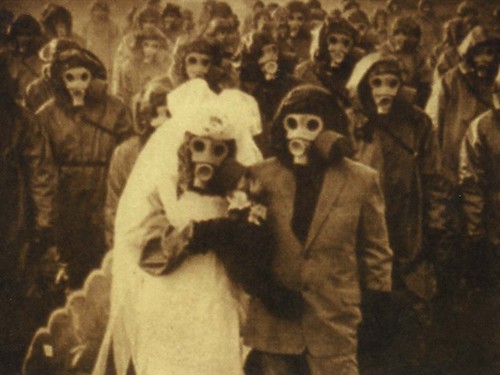
I guess this is emphasizing the need to publicly display something, which obviously isn't just love. These "themes" as simple as they can be, make a big deal about something that is sacred. But of course, society, as the society from Sand's time, feels the need to advertise. Anyways- I found this very entertaining.
Monday, December 20, 2010
Indiana by George Sand
It took me a long time before I could finally get my hands on this book. I first read a cruel excerpt of this in a book about George Sand, and it ended right where they threw themselves off the cliff. Oh, the despair! I was dying to know what happened to them!

"[...] everything was linked to a certain ability to create delusions, to an ardent aspiration towards something that was nor memory, nor expectation, nor hope, nor regret, but desire in all its consuming intensity. She lived like this for weeks and months beneath the tropical sky, loving, knowing, cherishing only a shadow, going only more deeply into a dream."
Maybe due to this "dreaming", she was all the more desperate to give herself to the embodiment of this ideal- or what she thought was her ideal. Do dreams bear desperation?
"She made for herself a world apart, which consoled her fro the one in which she was forced to live."
"Who can relate the dreams of the poet before his emotion has cooled so that he can write them down for us?"
He still loses something...he distorts it so that the mind's of cattle can criticize it. This sick reality is so cruel- this process of transferring from the dream to the practical.
"It was with these thoughts in mind that I asked you to put on this white dress; it's your wedding-dress, and that rock jutting out over the lake is the altar that awaits us."
Morbid romanticism.
"[...] and how the things of this life appear in their true light just when we are about to put an end to them."
And how miserably ironic. As if destiny mocks the pathetic attempt, letting us know that we still don't know the whole story. Oh, to live as if it was our last day! How different that would be!
"[...] there are memories we take the sine off by recounting them."
Memories can be pried open too much by the increasing dependence of the joy they provided. Then, they cease to become memories and instead turn into a source of a high, just like any other drug. This distorts their essence.
"What can the heart that has not suffered understand of happiness?"
One simple word: contrast!
----------------------------------------------------------------------------------------------
Which was stronger?- Ralph or Indiana? Indiana truly did sacrifice herself for most of her life, but then gave vent to her passions and wished to escape her vitues- claiming she deserved this freeedom. While Ralph had all the virtues of Indiana, and yet buried it within himself. I think Ralph was stronger because he didn't expect a reward unlike Indiana. He thought himself beneath a reward, giving him a noble character. Indiana broke and gave in to "temptation" over and over, even George Sand called her character weak.
The concept of suicide, and discovering this world once again is extremely interesting. (Of course, I only mean this from a literary point of view, since suicide in real life is of course tragic.) For only when we have nothing left to lose do we have everything to gain. To get to the pont where verything is viewed as temporary and insignificant-to treasure nothing-that requires a lot of suffering. And yet, when we let go of life, then we can truly grasp it, then one can become part of the "harmony", to quote Rilke. When one takes himself OUT of his existence, only then can he truly admire and observe it. But easily said, when one has things to treasure, one has the luxury of looking at this as a concept (even from a literary point of view), as a possible choice. How does one let go of one's treasures consciously, without any suffering required? Is it even possible, and if so, is it really sincere? It is so sad, because being "sober"one desires this uncaring attitude, and yet, it cannot soberly be achieved. It will remain an idea, something vague...
Suicide as a literary concept has a very romantic feel to it- a couple of books come to mind such as Balzac's Lost Illusions. The poet, through despair, knows there isn't a way out, and so- coward that he is (because they usually are cowards, and that's what makes them passive)- and weak, he gives in to the ultimate lure of the ideal suicide. And of course it is very tempting, to take control of the world and show fate that they too can choose their destiny, even though in reality they cannot. But after all, that is the charm of the poet, his weakness and loneliness makes him sensitive to Genius. I don't condemn them at all- actually I personally think that for the literary poet, happiness is impossible, and suicide is their only suitable death. Because there is this wonderful drama and tragedy about it, that gives their death such feeling and emotion. Which is so individual, depicting one last time the trace of their existence.
I was curious what the blogging world would say on such a topic: suicide as a literary concept. This blog was interesting, giving a historical view on this concept through literature. Then, unexpectedly, Wikipedia comes up with "Suicide in 19th Century Russian Literature" and there is Gogol! I did read the Nevsky Prospekt, and am very surprised that I haven't commented on it. Poor Liza by Karamzin was already on my to-read list. Must get to it! (I actually found it here in pdf format!)
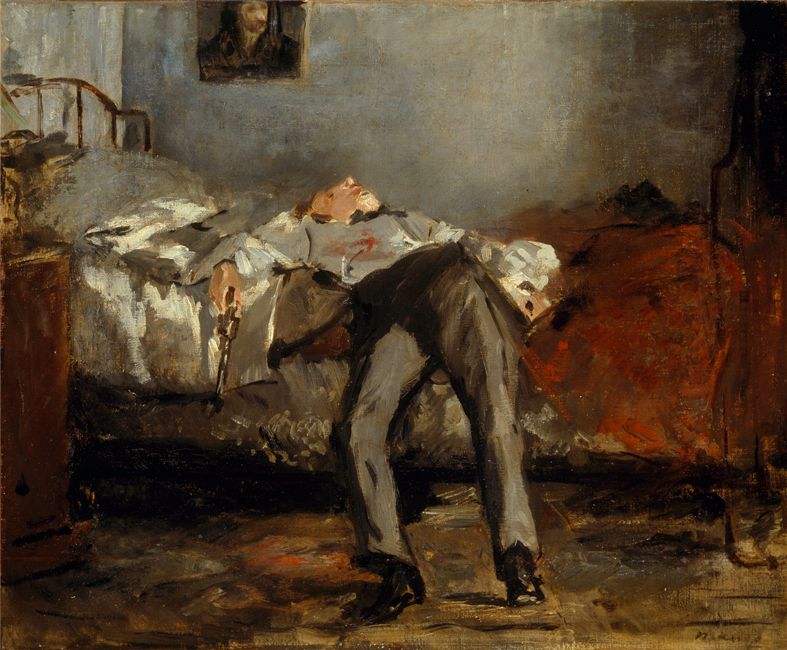
In art, I found a marvelous blog that features this excellent collection of paintings/images on the topic of suicide. Tastefully picked.
My favorite, and appropriately French, The Suicide by Édouard Manet:


"[...] everything was linked to a certain ability to create delusions, to an ardent aspiration towards something that was nor memory, nor expectation, nor hope, nor regret, but desire in all its consuming intensity. She lived like this for weeks and months beneath the tropical sky, loving, knowing, cherishing only a shadow, going only more deeply into a dream."
Maybe due to this "dreaming", she was all the more desperate to give herself to the embodiment of this ideal- or what she thought was her ideal. Do dreams bear desperation?
"She made for herself a world apart, which consoled her fro the one in which she was forced to live."
"Who can relate the dreams of the poet before his emotion has cooled so that he can write them down for us?"
He still loses something...he distorts it so that the mind's of cattle can criticize it. This sick reality is so cruel- this process of transferring from the dream to the practical.
"It was with these thoughts in mind that I asked you to put on this white dress; it's your wedding-dress, and that rock jutting out over the lake is the altar that awaits us."
Morbid romanticism.
"[...] and how the things of this life appear in their true light just when we are about to put an end to them."
And how miserably ironic. As if destiny mocks the pathetic attempt, letting us know that we still don't know the whole story. Oh, to live as if it was our last day! How different that would be!
"[...] there are memories we take the sine off by recounting them."
Memories can be pried open too much by the increasing dependence of the joy they provided. Then, they cease to become memories and instead turn into a source of a high, just like any other drug. This distorts their essence.
"What can the heart that has not suffered understand of happiness?"
One simple word: contrast!
----------------------------------------------------------------------------------------------
Which was stronger?- Ralph or Indiana? Indiana truly did sacrifice herself for most of her life, but then gave vent to her passions and wished to escape her vitues- claiming she deserved this freeedom. While Ralph had all the virtues of Indiana, and yet buried it within himself. I think Ralph was stronger because he didn't expect a reward unlike Indiana. He thought himself beneath a reward, giving him a noble character. Indiana broke and gave in to "temptation" over and over, even George Sand called her character weak.
The concept of suicide, and discovering this world once again is extremely interesting. (Of course, I only mean this from a literary point of view, since suicide in real life is of course tragic.) For only when we have nothing left to lose do we have everything to gain. To get to the pont where verything is viewed as temporary and insignificant-to treasure nothing-that requires a lot of suffering. And yet, when we let go of life, then we can truly grasp it, then one can become part of the "harmony", to quote Rilke. When one takes himself OUT of his existence, only then can he truly admire and observe it. But easily said, when one has things to treasure, one has the luxury of looking at this as a concept (even from a literary point of view), as a possible choice. How does one let go of one's treasures consciously, without any suffering required? Is it even possible, and if so, is it really sincere? It is so sad, because being "sober"one desires this uncaring attitude, and yet, it cannot soberly be achieved. It will remain an idea, something vague...
Suicide as a literary concept has a very romantic feel to it- a couple of books come to mind such as Balzac's Lost Illusions. The poet, through despair, knows there isn't a way out, and so- coward that he is (because they usually are cowards, and that's what makes them passive)- and weak, he gives in to the ultimate lure of the ideal suicide. And of course it is very tempting, to take control of the world and show fate that they too can choose their destiny, even though in reality they cannot. But after all, that is the charm of the poet, his weakness and loneliness makes him sensitive to Genius. I don't condemn them at all- actually I personally think that for the literary poet, happiness is impossible, and suicide is their only suitable death. Because there is this wonderful drama and tragedy about it, that gives their death such feeling and emotion. Which is so individual, depicting one last time the trace of their existence.
I was curious what the blogging world would say on such a topic: suicide as a literary concept. This blog was interesting, giving a historical view on this concept through literature. Then, unexpectedly, Wikipedia comes up with "Suicide in 19th Century Russian Literature" and there is Gogol! I did read the Nevsky Prospekt, and am very surprised that I haven't commented on it. Poor Liza by Karamzin was already on my to-read list. Must get to it! (I actually found it here in pdf format!)
In art, I found a marvelous blog that features this excellent collection of paintings/images on the topic of suicide. Tastefully picked.
My favorite, and appropriately French, The Suicide by Édouard Manet:
Sunday, November 7, 2010
Lélia by George Sand

"Isn't it sad to revive centuries that no longer exist and force them to entertain us now? Aren't these costumes of the past, which represent vanished generations, a frightening lesson to make us recall the brevity of human life in the midst of all this drunken festivity (...) They have passed on without dreaming of the generations that preceded them or of the ones to follow, without dreaming that they themselves, who were covered with gold and perfume and who surrounded themselves with luxuries, were awaiting the cold of the shroud and the oblivion of the tomb."
Morbid truth. Depressing!
"Nature has nothing rare enough within the treasuring of its naive joys to appease the thirst for happiness within us. We must have heaven, and we don't have it!
That is why we seek heaven in a creature like ourselves, and we expand on this creature all that high energy we've been given to use more nobly. We refuse God the emotion of adoration, an emotion which was put in us to return to God alone. We transfer it to an incomplete, feeble human being who becomes the god of our idolatrous cult."
"My God, is love only to be found in a desirous heart, in a suffering imagination, in the dreams which lull us during lonely nights? Is love an impalpable breath? Is love a meteor that burns and dies. Is it a world? My God, what is love?"
"Reverie can evoke nothing, because in the creations of thought nothing is as beautiful as brute, savage nature. One must look and feel before nature: the greatest poet invents the least."
Nothing in our minds can compare to the spontaneity of nature... it is the ultimate continuously living and refreshing masterpiece- the poet just needs to learn how to describe nature- something that is impossible to do perfectly. For to describe is to analyze. To analyze is to take away from the real meaning. A poet needs to learn how to enjoy nature- and let that be expressed.
"But what use have these voyages been to me? Have I ever seen anything which resembled my fantasies? Oh, how poor nature seemed to me, the sky leaden and the sea narrow, in contrast to the lands, skies and oceans that I crossed in my immaterial flight! What beauty is left to charm us in real life, what strengths are left to enjoy and admire in the human soul when the imagination has spend everything in advance by an abuse of its powers?"
This spending in "advance" was an abuse to the imagination's powers because it has a limit, it only goes so far as our mind has learned. The imagination cannot imagine something that is not connected to something that already exists: it is forever dependent on reality. It would be like craving some spice in a far off land that no one has ever discovered. I suppose the "pleasures" of the imagination consists mostly in the element of disillusion- taking reality and blurring it. Then it goes beyond the reality, into something more, or less- an added ingredient that creates the perfect realm. We fancy whatever we would like to happen in the reality. In the end, it always comes back to reality.
"How grave and solemn are those cries of time, which sound like a death cry, breaking indifferently on the resonant walls of dwellings or on echoless tombs."
"You are right to say that poetry has led men astray. She has desolated the real world, cold, poor, and wretched as it is compared to the dreams she creates. Drunk with her promises, lulled by her sweet mockeries, I could never resign myself to reality. Poetry has created other sensitives in me that nothing on earth could satisfy (...)"
The disadvantages of the imagination: it creates a gap between reality and dreams. This gap provides such a contrast that the poet dreams while looking at his own reality. This shocking contrast can "lead men astray". Meaning: they obsess over something they could never achieve.
"Day by day this power of love increased, exciting my sensitivity and spreading itself unrestrainedly around me. I threw all my thoughts, all my strength into the void of an elusive universe which sent me back all my sensations blunted."
"There is a refuge from God: nothingness."
"Rein in the desire of your ardent soul. Prolong this blind hope and this childishness of the heart with all your strength. These qualities live only for a day and never return. Govern wisely, guard vigilantly, and spend frugally the treasure of your illusions."
There is a fine balance between sucking your imagination dry, and enjoying them cautiously while they last. That is the difference between Sténio- who worshiped the present: nature and all its beauty- and Lélia- who craved for more and more and enjoyed them too much. To a point where they ceased to be illusions but food to feed the soul. They become a form of sustenance and ceased to be concepts and ideals.
"In the silence of the fields, amid austere country life, it is always acknowledged as the voice of God."
No one who lives so close to nature can really treasure and have respect for it without involuntary belief in God- as if believing was the same thing as acknowledging the existence of nature. this shows the wisdom of the ones who are surrounded by nature: an instinctive wisdom.
-----------------------------------------------------------------------------------
I really enjoyed this book. It brought me a more in depth perspective on living in illusions, and living in reality. Sténio lived in a romanticized reality, that worshiped the real in such an honest and youthful way. His romantic ideas found source in the nature he saw. Lélia is a very interesting example on the life in the unreal- when the real becomes dull and unexciting while the mind is constantly spent in fleeting thoughts, thoughts that only give momentary pleasure. I take this character to be as a warning, as Sténio warned the young girl- to be careful how one uses one's illusions, and not to make more of them- expect more of them- than one is meant to. Because then, they cease to be what they are.
It was curious how she found refuge in the silent and solitary and urged the blazing youth to do the same. To give up his youth, and really, become her. She, who had so much suffering. She shouldn't have killed his love for reality by pointing out the cold aspects that make it up= she should have left him in his youth, instead of trying to et him out. I think she was threatened by it, and saw it as a sort of disease- because of her personal experiences.
Magnes was an example of the restraining of one's nature, and how one can't escape one's nature through suppression. It is bound to come out and be worse than before. I wonder why Sand had Magnes kill Lélia. What significance does it show? The one who suppressed his desires killed the one who indulged too much in them. Something to think about.

Tuesday, December 15, 2009
Mauprat by Sand
"We cannot change the essence of our being, but we can direct our various facilities to a good end, and almost succeed in making our very faults useful: to do this, moreover, is the great secret and the great problem of education."
I think education only helps the mind, our nature and our essence is deeper than the mind- it runs into the soul. The mind will only help for so long, when nature takes over, logic is thrown out, and our basic impulses take over. With or without education. Even with this new "direction" of our faults, in a second everything could be lost- there is not telling what our nature will do.
"Learn to distinguish between love and desire; desire seeks to destroy the obstacles which it encounters, and perishes on the ruins of a vanquished virtue; love wishes to live, and, that it may do so, it wishes to see the object of its worship defended for a long tie by that diamond wall whose strength and splendor constitute its value and beauty."
"There are beings who pass away, after reflecting all that is beautiful and grand in the moral universe, without finding the means, and without even feeling the need of manifesting themselves to others."
"...so naturally does the past clothe itself in beautiful or softened forms in the brain of the young- presumptuous masters of the future."
The young will not escape, the past will follow them into the future.
"We all need to be loved in order that the good in us may be developed, but we need to be loved each differently, one with unwearying indulgence, another with steady severity."
Love is so complex and so sophisticated. It is as unique as each grain of sand, as each person that ever lived...
"Man is born with more or less of passions, with more or less ability for turning them to a good or a bad account in society."
I do not agree. So man is a bundle of passions that can only divert them in a direction for it to have a good or bad impact on society. As if it is up to our will! Nature cannot be overcome by the will, much less by education. It reminds me of the theory- that the environment is responsible of directing our passions... No, the moral is that on one hand Bernard was an animal and could not control his passions because he was not educated, while Edmee had equally the same passions but could control them because she was educated. And as he advanced in his education- he controlled his passions better. i firmly believe education doesn't help much with the essence of our being. Also, Sand emphasizes love- which can be true. In some cases I think Edmee was a little too noble for my taste- she didn't give in once. This is too much credit to the woman.
--
Pub by Da Capo Press
I think education only helps the mind, our nature and our essence is deeper than the mind- it runs into the soul. The mind will only help for so long, when nature takes over, logic is thrown out, and our basic impulses take over. With or without education. Even with this new "direction" of our faults, in a second everything could be lost- there is not telling what our nature will do.
"Learn to distinguish between love and desire; desire seeks to destroy the obstacles which it encounters, and perishes on the ruins of a vanquished virtue; love wishes to live, and, that it may do so, it wishes to see the object of its worship defended for a long tie by that diamond wall whose strength and splendor constitute its value and beauty."
"There are beings who pass away, after reflecting all that is beautiful and grand in the moral universe, without finding the means, and without even feeling the need of manifesting themselves to others."
"...so naturally does the past clothe itself in beautiful or softened forms in the brain of the young- presumptuous masters of the future."
The young will not escape, the past will follow them into the future.
"We all need to be loved in order that the good in us may be developed, but we need to be loved each differently, one with unwearying indulgence, another with steady severity."
Love is so complex and so sophisticated. It is as unique as each grain of sand, as each person that ever lived...
"Man is born with more or less of passions, with more or less ability for turning them to a good or a bad account in society."
I do not agree. So man is a bundle of passions that can only divert them in a direction for it to have a good or bad impact on society. As if it is up to our will! Nature cannot be overcome by the will, much less by education. It reminds me of the theory- that the environment is responsible of directing our passions... No, the moral is that on one hand Bernard was an animal and could not control his passions because he was not educated, while Edmee had equally the same passions but could control them because she was educated. And as he advanced in his education- he controlled his passions better. i firmly believe education doesn't help much with the essence of our being. Also, Sand emphasizes love- which can be true. In some cases I think Edmee was a little too noble for my taste- she didn't give in once. This is too much credit to the woman.
--
Pub by Da Capo Press
Friday, December 4, 2009
Marianne by George Sand
"Love is a madness, a wild dream that carries one into impossible realms."
Beautiful- the very word; realms. Something beyond us, beyond our human life.
"Generally speaking, those [women] who fascinate us and resist us remain mysterious to us. Those who give themselves to us lose all prestige and after our senses have drunk to the full of them, we cease to follow the movements of their souls."
I haven't come across the concept of the motion of the soul...What does she mean by that? That our souls move within ourselves, a sort of person inside ourselves- yet it is the real us? Maybe it is the real us, and the physical, the flesh is just an accessory...
I am not talking about the actual "seeing" of the soul. Maybe each soul can see (feel) each other with their own eyes...
"No words can describe some things. The more one says, the less one sees. You see, Pierre, nature is like love, it's in the heart and you musn't talk about it too much. You diminish what you try to describe...I only what there is between the sky and myself. I have no part in it at all. If I think of you, in my odd way I am you and I cease to exist. That, to me, is real happiness, real poetry, real understanding."
Words ruin it. They really do. There is no possible way to describe accurately the purity, the perfection of nature. The human mind is too inferior to even begin to conceive of the beauty and majesty- let alone describe it with our language... Ceasing to exist is real understanding... that is an interesting idea.
"When I see the deeply thoughtful look on some peasant's face, when I see the exuberant joy in some children, when I see the apparently rapturous happiness of small birds and blissful peace of flowers in the moonlight, I often ask myself if having a sacrifice explanation of the world is an advantage. Does the effort of reflection remove from unconscious mental activity its greatest charm? And does it remove from sensation its greatest power?"
Very interesting idea. And throughout the book, the answer is yes it does remove the charm and power,one needs to admire nature for the sake of admiration, and not to try to analyze it. I myself tried so many times to pinpoint the sensation that nature had effected upon me- but it is impossible. One has to realize, the things themselves are poetry. They just exist to be poetry not to inspire it.
Of course men have come close to accurately describe it- as close as humans can get. It is the search for man, as they get closer and closer to the real thing, the real poetry. And yet, they shall never touch it- our humanity prevents it, we are bound to earth- not to roam the skies, the heavens... even if our imaginations want to...
But that is why I do like the classics- and goodness me, there are darn good descriptions! :)
"Our love of the countryside and of nature will no longer be tinged with melancholy as before."
This was the first time I came across the idea- which I elaborated on one of Turgenev's books. Very fascinating concept.
-----------------------------------------------------------------------------------
I am not much of a fan of women authors. They have disappointed me many a time...But Sand is not like many women- throughout the centuries. She was beyond her times. I mean, she was so good, that the great masters of the time (Dostoevsky, Pushkin, Turgenev) idolized her. And that alone demands respect.
She is really pretty good. I can tell she was a remarkable woman, beautiful ideas, beautiful mind.

--
Pub by Carroll and Graf
Beautiful- the very word; realms. Something beyond us, beyond our human life.
"Generally speaking, those [women] who fascinate us and resist us remain mysterious to us. Those who give themselves to us lose all prestige and after our senses have drunk to the full of them, we cease to follow the movements of their souls."
I haven't come across the concept of the motion of the soul...What does she mean by that? That our souls move within ourselves, a sort of person inside ourselves- yet it is the real us? Maybe it is the real us, and the physical, the flesh is just an accessory...
I am not talking about the actual "seeing" of the soul. Maybe each soul can see (feel) each other with their own eyes...
"No words can describe some things. The more one says, the less one sees. You see, Pierre, nature is like love, it's in the heart and you musn't talk about it too much. You diminish what you try to describe...I only what there is between the sky and myself. I have no part in it at all. If I think of you, in my odd way I am you and I cease to exist. That, to me, is real happiness, real poetry, real understanding."
Words ruin it. They really do. There is no possible way to describe accurately the purity, the perfection of nature. The human mind is too inferior to even begin to conceive of the beauty and majesty- let alone describe it with our language... Ceasing to exist is real understanding... that is an interesting idea.
"When I see the deeply thoughtful look on some peasant's face, when I see the exuberant joy in some children, when I see the apparently rapturous happiness of small birds and blissful peace of flowers in the moonlight, I often ask myself if having a sacrifice explanation of the world is an advantage. Does the effort of reflection remove from unconscious mental activity its greatest charm? And does it remove from sensation its greatest power?"
Very interesting idea. And throughout the book, the answer is yes it does remove the charm and power,one needs to admire nature for the sake of admiration, and not to try to analyze it. I myself tried so many times to pinpoint the sensation that nature had effected upon me- but it is impossible. One has to realize, the things themselves are poetry. They just exist to be poetry not to inspire it.
Of course men have come close to accurately describe it- as close as humans can get. It is the search for man, as they get closer and closer to the real thing, the real poetry. And yet, they shall never touch it- our humanity prevents it, we are bound to earth- not to roam the skies, the heavens... even if our imaginations want to...
But that is why I do like the classics- and goodness me, there are darn good descriptions! :)
"Our love of the countryside and of nature will no longer be tinged with melancholy as before."
This was the first time I came across the idea- which I elaborated on one of Turgenev's books. Very fascinating concept.
-----------------------------------------------------------------------------------
I am not much of a fan of women authors. They have disappointed me many a time...But Sand is not like many women- throughout the centuries. She was beyond her times. I mean, she was so good, that the great masters of the time (Dostoevsky, Pushkin, Turgenev) idolized her. And that alone demands respect.
She is really pretty good. I can tell she was a remarkable woman, beautiful ideas, beautiful mind.

--
Pub by Carroll and Graf
Subscribe to:
Posts (Atom)

 Posts
Posts


