Showing posts with label Kundera. Show all posts

Tuesday, July 14, 2015

Farewell Waltz by Kundera


"It seemed to him that with every oversalted mouthful he was tasting Kamila's tears, and it was his own guilt that he was swallowing."

"For a moment his photograph had acquired a three-dimensional reality, a warmth, a weight, and then had again become an impalpable. colorless image reproduced in thousands of copies and thus all the more abstract and unreal."

"Blonde hair and black hair are the two poles of human nature. Black hair signifies virility, courage, frankness, activity, while blonde hair symbolizes femininity, tenderness, weaness, and passivity.Therefore a blonde is in fact doubly a woman."

"I'm curious about how pigments exercise their influence over the human soul," said Bertlef doubtfully."

"If black hair became a universal fashion, life in this world would clearly be better. It would be the most useful social reform ever achieved."

Now, he's just making fun...

"Why do you think they try to seduce us? Solely to defy and humiliate their fellow women. God instilled in women's hearts a hatred of other women because He wanted the human race to multiply.

Both Klima and Ruzena have groups of their own sex trying to advise them what to do in situation. Basically: what men and women do in case of an unwanted pregnancy.

"Just as love makes the beloved woman more beautiful, anxiety inspired by a woman one fears brings her smallest flaws into disproportionate relief..."

"[...] the sadness that emanated from these words of Klima's had for her a pleasant odor. She sniffed at it as if it were roast pork."

Sadness is very attractive in a vain kind of way.

"Only now having lost its charm, was the mouth suddenly what it was, a real mouth, an nonindustrial orifice through which the young woman had already taken in cubing meters of dumplings, potatoes, and soups, a mouth containing teeth pocked with fillings and saliva that was no longer an intoxicating liqueur but the cousin of a glob of spit."

Pregnancy = Power

"It thrills me so to think of giving you a child."

This is such power- overrides that he has a wife!! She isn't even in a position of saying such a thing, but just because she's pregnant- he has to pay for it. It's funny, but some women take pleasure in blaming the man for his natural "reaction". It takes two to tango.

Marriage Metaphor:
"Every time we climbed up there," Skreta went on, "Suzy tried to convince me we should get married. And I'd be so worn out by the climbing that I felt old and that there was nothing left for me but to marry. But in the end I always controlled myself, and when we came back down from the scening view my strength would come back and I'd no longer want to get married. But one day Suzy made us take a detour, and the climb took so long and I agreed to get married even before we got to the top. And now we're expecting a child, and I have to think a bit about money."

"Olga was actually one of those modern women who readily divide themselves into a person who lives life and a person who observes it."

"If Olga had been a little more foolish, she would have found herself quite pretty. But since she was an intelligent girl, she considered herself much uglier than she really was, for she was actually neither ugly nor pretty, and any man with normal aesthetic requirements would gladly spend the night with her."

"I picture my soul with a strong chin and sensual lips, but my chin is small and so is my mouth. If I'd never seen myself in a mirror and had to describe my outside appearance from what I know of the inside of me, the portrait wouldn't look at all like me! I am not at all the person I look like!"

"You need to have at least one certainty: to remain in control of your own death and o the ability to choose its time and manner. You can put up with a lot of things. You know you can get away from people whenever you want."

"It's incredible that hideous-looking individuals decide to procreate. They probably imagine that the burden of ugliness will be lighter if they share it with their descendants."

"Impelled merely by the desire to perpetuate the species, mankind will end up something itself on this small planet. But the natalist propaganda mill grinds on, and the public is moved to tears by pictures of nursing mothers and infants making faces. It disgusts me. It chills me to think that, along with millions of other enthusiasts, I could be bending over a cradle with a silly smile." 

"Something that always utterly disgusts me about mankind is seeing how its cruelty, its baseness, and its stupidity manage to wear the lyrical mask. She sends you to your death, and she experiences it as a romantic feat of wounded love. And you mount the scaffold because of an ordinary narrow-minded woman, feeling that you are playing a role in a tragedy Shakespeare wrote for you." 

"They wished to take revenge on and torpedo with the repulsiveness of their bodies the glory of female beauty, for they knew that bodies, whether beautiful or ugly, are ultimately all the same and that the ugly overshadow the beautiful as they whisper in men's ears: Look, this is the truth of the body that bewitches you! Look, this big flabby tit is the same thing as the breast you so madly adore." 

"When he is more mature he will find out that things are transient, and he will become aware that beyond one woman's horizon there opens up a horizon of yet more women." 

"Your dirt too, sir, is vanity, and your vanity is dirty." 

A reference to a toothache (Notes from the Underground):
"He cannot sit down. Jealousy is like a raging toothache. One cannot do anything when one is jealous, not even sit down. One can only come and go. Back and forth." 

"[...] it was because of her that their marriage was menaced by a bomb deposited in another woman's belly, by a charge timed to blow everything up in seven months." 

Everyone is death with anxiety- with things that mean the world to them- and in a second don't matter. Like for Ruzena and Jakab- they eventually become indifferent to their world/anxieties.

Kima and Mrs. Klima have a very sick love. They know everything about each other and the relationship is seeping with jealousy and regret, They have lost the connection long ago but don't want to admit it.


Further CONNECTIONS with Dostoevsky:
References Crime and Punishment

"Yes, there was something that brought him close to Raskolnikov: the pointlessness of the murder, its theoretical nature." 

and

"Jakub was amazed that his act was so light, so weightless, amazed that it did not overwhelm him. And he wondered if this lightness was not more terrifying than the Russian character's hysterical feelings." 

"'The police don't have much influence over the infernal powers,' the inspector said."

---------------------------------------------------------------------------------------------------------------------

He spun around this controversial topic very elegantly. I really liked each person's perspective/incentives towards abortion and pregnancy. Klima had to remove this from his wife's knowledge so wanted an abortion. Ruzena was a "stupid slut" apparently with a "good heart" and used her pregnancy as a way of getting money/fame. The poor girl was very CLOSE to thinking though!  Mrs. Klima is a typical housewife suffering from paranoia and yet beautiful. The Doctor helped Klima because he wanted fame.

Interesting story- of course I take it more of a farce than discussing the topic of abortion seriously. I guess it shows what happens to certain individuals when such a situation presents itself.

Pub: Harper Perennial


Wednesday, March 18, 2015

Immortality by Kundera

"There is a certain part of all of us that lives outside of time. Perhaps we become aware of our age only at exceptional moments and most of the time we are ageless."

"That finding leads us to a shocking conclusion: a gesture is more individual than an individual. [...] it is gestures that use us as their instruments, as their bearers and incarnations."

Gestures are more unique and rare than humans.

"Everything else is without importance, from the Creator's point of view, and is only a play of permutations and combinations within a general program, which is not a prophetic anticipation of the future but merely sets the limits of possibilities within which all power of decision has been left to chance."

"When we are thrust out into the world just as we are, we first have to identify with that particular throw of the dice, with that accident organized by the divine computer: to get over our surprise that precisely this (what we see facing us in the mirror) is our self. Without the faith that our face expresses our self, without that basic illusion, that archillusion, we cannot live, or at least we cannot take life seriously. And it isn't enough for us to identify with our selves, it is necessary to do so passionately, to the point of life and death. Because only in this way can we regard ourselves not merely as a variant of a human prototype but as a being with its own irreplaceable essence." 

"She would go out into the street holding the flower before her eyes, staring at it tenaciously so as to see only that single beautiful blue point, to see it as the last thing she wanted to preserve for herself from a world she had ceased to love."


"Suddenly frightened by her hatred, she said to herself: the world is at some sort of border; if it is crossed, everything will turn to madness: people will walk the streets holding forget-me-nots or kill one another on sight"

As if those two were the same thing...

"Hate traps us by binding us too tightly to our adversary. This is the obscenity of war: the
intimacy of mutually shed blood, the lascivious proximity of two soldiers who, eye to eye, bayonet each other."

"The purpose of the poetry is not to try to dazzle us with an astonishing thought, but to make one moment of existence unforgettable and worthy of unbearable nostalgia."

"That instant when Agnes suddenly, without preparation, lifted her arm in a flowing, easy motion was miraculous. How was it possible that in a single fraction of a second, and for the very first time, she discovered a motion of the arm and body so perfect and polished that it resembled a finished work of art?"

A gesture becoming a masterpiece in itself.

"It was as if two distant times had suddenly met in a single second and two different women in a single gesture."

"[...] things exist in their essence even before they are materially realized and named."

Fully believe that. 


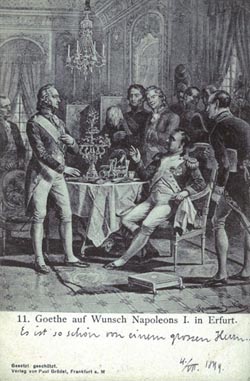
Bettina and Goethe: "[...] but I soon understood that what you wanted to show me was not a drawing but a pistol that you are holding, aiming far into my immortality." She wanted to follow him into immortality.

"And I realized that my Faust didn't interest them at all and that the show they wished to see was not the puppets I was leading around the stage, but me myself! Not Faust, but Goethe!"

When it comes to revering authors- we must admire their work not their personal lives.

"There are two methods for cultivating the uniqueness of the self: the method of addition and the method of subtraction. "
Adding: " But the matter becomes less idyllic if a person decides to add love for communism, for the homeland, for Mussolini, for Catholicism or atheism, for fascism or antifascism"

"And since for contemporary man reality is a continent visited less and less often and, besides, justifiably disliked, the findings of polls have be- some a kind of higher reality, or to put it differently: they have become the truth."

Please tell us the REALITY.

"Things will lose ninety percent of their meaning and will become light. In such a weightless environment fanaticism will disappear. War will become impossible."

"Strange: she was up to her ears in love with him and yet she had no interest in him. I could even say: she was up to her ears in love with him and precisely for that reason she had no interest in him.  ([...] The emotion of love gives all of us a misleading illusion of knowing the other. "
We can see a parallel between Laura and Bettina: 
"[...] the cause and object of her love was not Goethe, but love."

American culture:
" As soon as feelings are seen as a value, everyone wants to feel; and because we all like to pride ourselves on our values, we have a tendency to show off our feelings."

"It is part of the definition of feeling that it is born in us without our will, often against our will. As soon as we want to feel {decide to feel, just as Don Quixote decided to love Dulcinea), feeling is no longer feeling but an imitation of feeling, a show of feeling. This is commonly called hysteria."

"Nineteenth-century writers often ended their novels with marriage. This was not because they wanted to save the love story from marital boredom. No, they wanted to save it from intercourse!"

Ahh-- now I understand Jane Austen.... :)

The Russian soul- "The modern age, based on Cartesian critical thought, only penetrated there after a lag of some one or two hundred years. Homo sentimentalis thus failed to find there a sufficient counterweight and became his own hyperbole commonly known as the Slavic soul."
Everything is forgiven if it's done in the name of love. France has ceased to feel.

"The basis of the self is not thought but suffering, which is the most fundamental of all feelings."

"Beauty, more than ugliness, reveals the nonindividuality, the impersonality of a face."

"And that's life: it does not resemble a picaresque novel in which from one chapter to the next the hero is continually being surprised by new events that have no common denominator. It resembles a composition that musicians call a theme with variations."

About the horoscope. How true.

"Your life will always be built from the same materials, the same bricks, the same problems, and what will seem to you at first "a new life" will soon turn out to be just a variation of your old existence."

"An individual does not receive a share of indecent fantasy from a lover by means of Telephone but by means of this impersonal (or superpersonal or sub-personal) stream. To say that this river that runs through us is impersonal means that it does not belong to us but to him who created us and made it flow within us; in other words, that it belongs to God or even that it is God or one of his incarnations."

That's saying something. Sexuality is a spiritual creation.

"That's why love, in order to prove itself true, wishes to escape the sensible, wishes to reject moderation, doesn't wish to seem probable; longs to change into the delires actifs de la passion (let's not forget Eluard!), in other words, wishes to be mad! "

"[...] no episode is a priori condemned to remain an episode forever, for every event, no matter how trivial, conceals within itself the possibility of sooner or later becoming the cause of other events and thus changing into a story or an adventure." 

----------------------------------------------------------------------------------
So many ideas iin this book! Really I haven't even begun to process all of them. I must read it again and again... Throughout my entire lifespan.


Saturday, November 8, 2014

Identity by Kundera


"Remembering our past, carrying it with us always, may be the necessary requirement for maintaining, as they say, the wholeness of the self. To ensure that the self doesn't shrink, to see that it holds on to its volume, memories have to be watered like potted flowers, and the watering calls for regular contact with the witnesses of the past, that is to say, with friends."

"[...] every one of us is immersed in a sea of salivas that blend and make us into one single community
of salivas, one humankind wet and bound together."

Never thought about saliva in that way- we are all connected by saliva 0_0...

"The child makes us care about the world, think about its future, willingly join in its racket and its turmoils, take its incurable stupidity seriously."

"But what a sorry fate, to be the soul of a body cobbled together so offhandedly, whose eye cannot do its looking without being washed every ten, twenty seconds! How are we to believe that the person we see before us is a free, independent being, his own master? How are we to believe that his body is the faithful expression of whatever soul inhabits it?"

We are limited by the functions of our bodies. We will be forever imposed by it.

Great interruption to the story- asking the reader: "At what exact moment did the real turn into the unreal, reality into reverie ? Where was the border? Where is the border?" And what is the significance in this? 


Okay so basically in the end this woman which didn't really know herself, is finally heart and soul devoted to the one she loved- a deeper love developed. She realized that what she had was enough- and didn't want anything more. And that her identity was found in this love- this is the only way she could be her natural self. 
-----------------------------------------------------------------------------------------------
It's a sweet story- showing us that even we don't know who we are sometimes. That everything is flexible, and we adapt to different kinds of people, changing our faces as many times as it's convenient. Does that make us hypocritical? In the end- I don't think so- except that it's not real. And whether it's real is what matters to the individual (not to society). It affects you in the end. And I guess love helps to know ourselves, because someone loves you for who you are (even if you sometimes forget it). And they can always rekindle what you have forgotten (about yourself). This phrase: "Men don't look at me anymore." in the story is significant because she was thinking that maybe she didn't live enough as she should have. And maybe wanting some adventure... and not realizing that all she needed she already had. The point is not to have a stranger's gaze but your lover's- and it can be a difficult thing to learn (and probably more than once). 
Do we really know the one's we love? Or can do they always have the capability of surprising us and making us feel as if we have never known them at all?

Friday, October 10, 2014

Slowness by Kundera


"[...] in fact, I doubt that the hedonist ideal could ever be achieved; I'm afraid the sort of life it advocates for us may not be compatible with human nature."

Because hedonism is temporary- like he said, it brings more unhappiness than happiness. Later- he's asks again whether hedonism could be realized- in almost a desperate tone. 

"Imposing form on a period of time is what beauty demands, but so does memory. For what
is formless cannot be grasped, or committed to memory."

I like the way the woman constructed time and divided the night into 3 parts- prolonging arousal so that this can be impressed on the mind and make it more exciting instead of just listening to immediately instinct. "Conceiving their encounter as a form was especially precious for them, since their night was to have no tomorrow and could be repeated only through recollection." Therefore it was very important that it would be remembered in a form.

Slowness and remembering are connected.

"Vulva: noisy crossroads where all of chattering humankind meets, a tunnel the generations file through."

"It did not take place because Vincent's member is as small as a wilted wild strawberry, as a great-grandmother's thimble." 

The most entertaining personification I've come across so far- Kundera and the character's "member" having a dialogue...

All these characters are wonderfully justifying what they want to believe...

The play repeats itself again and again- these dynamics of dominant and submissive. Torture each other to infinity for selfish reasons. "Thus everything can go on and the play they just performed tonight for the first time will be repeated in the days and weeks to come."

"When things happen too fast, nobody can be certain about anything, about anything at all, not even about himself."

Yes- like he said- in a second your past seems so certain and calm, while now everything is chaotic and frightening.

"our period is obsessed by the desire to forget, and it is to fulfill that desire that it gives over to the demon of speed; it picks up the pace to show us that it no longer wishes to be remembered; that it is tired of itself; sick of itself; that it wants to blow out the tiny trembling name of memory."

I can agree with him even in this period- actually more so because now it's become the fashion to forget. People forget so easily nowadays- the most tragic catastrophes fade away in a few weeks.War, civil war, epidemics, natural disasters... pff everyone is too busy trying to forget his own existence

"[...] it stands up against the universe like Beethoven's Ninth Symphony, which, in the face of gloomy humankind, roars out its hymn to joy."

Absolutely stupendous.

------------------------------------
A story about people's need to be loved- I think. They reacted in certain ways because of wounded pride/feelings. The concept of dancers- people who live for the sensual pleasure of attention- is very interesting. The question was- whether we were all dancers- like the guy said about cameras, cameras are everywhere. And even without cameras, people can IMAGINE the abstract audience and pretend to be acting. This need for attention transfers them into the ELECT- and therefore makes their life meaningful and unique.
Characters and relations:
Madame T and Chevalier- she plays with him, constructing the entire night for her sole pleasure- Kundera writes that she was the only one which at least was the closest in finding happiness through hedonsim- pure sensuality.

Vincent and Julie- Vincent hates Berck and is very troubled by him, therefore uses Julie to forget things "the asshole/supreme portal" but in fact he's only interested in his ego boost- wherever he can get it from. Their performance in front of the imaginary stage portrays all of their interests. Vincent was acting for them, while Julie was acting because she liked Vincent, and also because she was humiliated by the pretentious company at the party I think he suffered because he was always in Pontevin's shadow, he could never become the real "dancer", so he used people like Julie which worshiped him to boost his ego. In this way, Chevalin was also used by Madame T for her own pleasure.
Berck/Immaculata/cameraman- Berck is one of the dancers in this story- so is Vincent's "mentor/best friend" Pontevin. Berck is in constant insecurity about having an audience and is in constant search for new things to keep it going. Immaculata poses a danger for him because it reminds him of his younger days when he was a "fool"- even though now he is just as a fool. Immaculata uses the cameraman in a sadistic way (because she is hurt that Berk doesn't want her); constantly wanting to see his proof of love to her by abusing him. He pretends to hate her but acting out of weakness- which she knows. Very sick.
the scientist- guy which was in extreme denial and wanted to be loved again by an audience- full of himself and constantly "protects" his ego- telling himself lies even when he realizes that everyone takes him as a joke

This story was also about forgetting. All characters were trying to forget something, and so they engaged in hedonism- no matter what kind, sexual or attention seekers... they were trying to run away from something- except for Madame T.

Why did the Chevalier and Vincent meet at the end? What do they have in common? Chevalier was used by the madame, while Vincent is an wana-be elect. And they didn't understand each other- Vincent wanted to boast about his lie (nothing happened that night) while the Chevalier was humiliated by the madame and didn't want to listen to him. Vincent actually insulted the Chevalier. What is the meaning?

The ending is very concrete: "No tomorrow. No audience" and that is where sensuality reigns for it can be kept in memory. For the audience disappears when they have found something else more entertaining, the memory itself is not kept. Like the children in Somalia. The people who entertain the audience are constantly fighting to have them be remembered. And no tomorrow- slowness with no tomorrow is what gives memory its sweetness. "and all that time he will be trying to stay as close as he can to the night as it melts inexorably in the light." The Chevalier and Madame T are the heroes in this story because they are striving to remember while everyone else strive to forget. Completely different attitudes aren't they? Maybe we should also strive to remember instead of forgetting- then our life would be more intricate instead of blurred and vague. For when we start running away- we never stop. We should go against the current of time, and cherish the memories- for that is all we have.

--
Pub- Trans Linda Asher.