Monday, July 18, 2016

Against the Syntehtic Portrait, For the Snapshot by Aleksandr Rodchenko, 1928


 File:1920s Rodchenko and Stepanova.jpg
“Any intelligent man will tell you about the photograph’s shortcomings in comparison to the painted portrait’ everyone will tell you about the character of the Mona Lisa, and everyone forgets that portraits were painted when there was no photography and that they were painted not of all the intelligent people but of the rich and powerful. Even men of science were not painted.

You need not wait around, intelligentsia; even now AKhRR artists will not paint you. True- they cant even depict the sum total, let alone .001 of a moment.

Now compare eternity in science and technology. In olden times a savant would discover a truth, and this truth would remain law for about twenty years. And this was learned and learned as something indisputable and immutable.

Encyclopedias were compiled that supplied whole generations with their eternal truths.

Does anything of the kind exist now?... No.

Now people do not live by encyclopedias but by newspapers, magazines, card catalogues, prospectuses, and directionaries.

Modern science and technology are not searching for truths, but are opening up new areas of work and with every day change what has been attained.” 


“It should be stated firmly that with the appearance of photographs, there can be no question of a single, immutable portrait. Moreover, a man is not just one sum total; he is many, and sometimes they are quite opposed.”


“Art has no place in modern life. it will continue to exist as long as there is a mania for the romantic and as long as there are people who love lies and deception.

Every modern cultured man must wage war against art, as against opium.

Photograph and be photographed!”

Not sure if I agree with that last part but… 


“Crystallize man not by a single ‘synthetic’ portrait, but by a whole lot of snapshots taken at different times and in different conditions.” (Nowadays, one may say selfies :))


“Paint the truth.”


“Value all that is real and contemporary.

And we will be real people, not actors.” 

--
Publishing Information: 
Russian Art of the Avant Garde Theory and Criticism Revised and Enlarged Edition edited by John E. Bowlt 

From Pictures to Textile Prints by Osip Brik, 1924


Caricature of Osip Brik, variant for the cover of the journal LEF (Left Front of the Arts), Alexander Rodchenko
“Moreover, the conviction is gaining ground that the picture is dying, that it is indissolubly linked with the forms of the capitalist regime, with its cultural ideology, that the textile print is not becoming the center of creative attention, and that the textile print and work on it are the apex of artistic labor.” 


“The easel picture is not only unnecessary to our contemporary artistic culture, it is also one of the most powerful brakes on its development.”


“The point is that easel painters do not deny the importance and necessity of other forms of artistic culture. They fully tolerate the existence of agit-posters, sketches for textile prints and book covers; they simply affirm that all these ‘subsidiary’ forms are inconceivable without easel painting, that easel painting is the creative base on which painterly culture is built.

Hence the conclusion: if you want to make good textile prints, learn to paint landscapes.”


“After mastering the ‘secrets’ of easel painting, he thereby masters the ‘secrets’ of any painterly work, whether it is a textile print, a book cover, a poster, or theatrical décor.” 


“Let us assume that partial coincidences are possible, that some of the devices can prove to be general; why should one craft prove to be fundamental vis-à-vis another? why should the making of a still life be more “fundamental” than that of a textile print? Why should one first of all learn how to do a still life and then undertake textile prints, and not vice versa?”


“But the easel painters forget that the picture is not science, but practice, that it establishes no ‘general’ tenets. The experience of the easel painter is not that of the artist in general, but is only the experience of a single, individual case of painterly labor.”


“All the same, work in industry will always be inferior for the easel painter. That is why it is not the easel painters who will discover the methods of this work, and not from easel painting that the solution of productional art problems will ensue.” 


“Indeed, artistic labor and factory work are still disunited. The artist is still an alien in the factory. People treat him with suspicion. They do not let him come too close. They do not believe him they cannot understand why he needs to know technolgocal processes, why he needs information of a purely industrial nature. His job is to draw, to make drawing-s and the factory’s job is to select suitable ones and to stick them onto the ready-made finished product.” 


“Hence the inevitable applied art- the result of the artist’s alienation from industry. Not receiving the necessary economic directives, he resorts, willy-nilly, to aesthetic stereotypes.

But what is the conclusion from this?

Forward! To overcome this alienation.

Forward! To the union of the artist and the factory.

And by no means back to pure easel painting, back to pictures.

The progressive artists are already under way- from the picture to the textile print, and of course, why will not turn back. But that is not enough. it is essential that the whole mass of our young artists should realize that this is the only true path and that it is precisely by this path that artistic culture will develop.” 


“The artistic culture of the future is being created in factories and plants, not in attic studios.

May the young artists remember this- unless they wish to turn up prematurely in the archives, together with the proud easel painters.” 

--
Publishing Information: 
Russian Art of the Avant Garde Theory and Criticism Revised and Enlarged Edition edited by John E. Bowlt 

Thursday, May 12, 2016

The Facts of Perception by Hermann Helmholtz 1878


"The problems which that earlier period considered fundamental to all science were those of the theory of knowledge: What is true in our sense perceptions and thought? and In what way do our ideas correspond to reality?"

"[...] we can discover the lawful regularities in the processes of the external world. And natural laws assert that from initial conditions which are the same in some specific way, there always follow consequences which are the same in some other specific way."
 
“Thus, even if in their qualities our sensations are only signs whose specific nature depends completely upon our make-up or organisation, they are not to be discarded as empty appearances. They are still signs of something - something existing or something taking place - and given them we can determine the laws of these objects or these events. And that is something of the greatest importance!”
“The fact that we become aware of these effects through frequently repeated trials and observations can be demonstrated in many, many ways. Even as adults we can still learn the innervations necessary to pronounce the words of a foreign language, or in singing to produce some special kind of voice formation. We can learn the innervations necessary to move our ears, to turn our eyes inward or outward, to focus them upward or downward, and so on. The only difficulty in learning to do these things is that we must try to do them by using innervations which are unknown, innervations which have not been necessary in movement previously executed. We know these innervations in no form and by no definable characteristics other than the fact that they produce the observable effects intended. This alone distinguishes the various innervations from one another.”
"These last points should be considered more fully. The volition for a specific movement is a psychic act, and the perceptible change in sensation which results from it is also a psychic event. is it possible for the first to bring about the second by some purely mental process? It is certainly not absolutely impossible. Whenever we dream, something similar to this takes place.
While dreaming we believe that we are executing some movement, and then we dream further that the natural results of this movement occur. We dream that we climb into a boat, shove it off from shore, guide it over the water, watch the surrounding objects shift position, and so on. In cases like this it seems to the dreamer that he sees the consequences of his actions and that the perceptions in the dream are brought about by means of purely Psychical processes. Who can say how long and how finely spun, how richly elaborated, such dreams may be! If everything in dreams were to occur in ultimate accordance with the laws of nature, there would be no distinction between dreaming and waking, except that the person who is awake may break off the series of impressions he is experiencing.
I do not see how a system of even the most extreme subjective idealism, even one which treats life as a dream, can be refuted. One can show it to be as improbable, as unsatisfactory as possible (in this connection I concur with the severest expressions of condemnation), but it can be developed in a logically consistent manner, and it seems to me important to keep this in mind. How ingeniously Calderon carried out this theme in Life Is a Dream is well known.
Fichte also believed and taught that the Ego constructs the Non-Ego, that is, the world of phenomena, which it requires for the development of its Psychical activities. His idealism is to be distinguished from the one mentioned above, however, by the fact that he considered other individuals not to be dream images but, on the basis of moral laws, to be other Egos with equal reality. Since the images by which all these Egos represent the Non-Ego must be in agreement, he considered all the individual Egos to be part of or emanations from an Absolute Ego. The world in which they find themselves is the conceptual world which the World Spirit constructs. From this a conception of reality results similar to that of Hegel.”
"Science must consider thoroughly all admissible hypotheses in order to obtain a complete picture of all possible modes of explanation. Furthermore, hypotheses are necessary to someone doing research, for one cannot always wait until a reliable scientific conclusion has been reached; one must sometimes make judgments according to either probability or aesthetic or moral feelings. Metaphysical hypotheses are not to be objected to here either.”
“Insofar as we recognise a law as a power analogous to our will, that is, as something giving rise to our perceptions as well as determining the course of natural processes, we call it a force. The idea of a force acting in opposition to us arises directly out of the nature of our simplest perceptions and the way in which they occur. From the beginning of our lives, the changes which we cause ourselves by the acts of our will are distinguished from those which are neither made nor can be set aside by our will. Pain, in particular, gives us the most compelling awareness of the power or force of reality. The emphasis falls here on the observable fact that the perceived circle of presentabilia is not created by a conscious act of our mind or will. Fichte's Non-Ego is an apt and precise expression for this. In dreaming, too, that which a person believes he sees and feels does not appear to be called forth by his will or by the known relations of his ideas, for these also may often be unconscious. They constitute a Non-Ego for the dreamer too. It is the same for the idealists who see the Non-Ego as the world of ideas of the World Spirit.”
“In general, it is clear that a distinction between thought and reality is possible only when we know how to make the distinction between that which the ego can and that which it cannot change. This, however, is possible only when we know the uniform consequences which volitions have in time. From this fact it can be seen that conformity to law is the essential condition which something must satisfy in order to be considered real.”
“'All things transitory
But as symbols are sent.' [Faust]
I take it to be a propitious sign that we find Goethe with us here, as well as further along on this same path. Whenever we are dealing with a question requiring a broad outlook, we can trust completely his clear, impartial view as to where the truth lies. He demanded of science that it be only an artistic arrangement of facts and that it form no abstract concepts concerning them, for he considered abstract concepts to be empty names which only hide the facts.”
“Every inductive inference is based upon the belief that some given relation, previously observed to be regular or uniform, will continue to hold in all cases which may be observed. In effect, every inductive inference is based upon a belief in the lawful regularity of everything that happens. This uniformity or lawful regularity, however, is also the condition of conceptual understanding. Thus belief in uniformity or lawful regularity is at the same time belief in the possibility of understanding natural phenomena conceptually. If we assume that this comprehension or understanding of natural phenomena can be achieved - that is, if we believe that we shall be able to discern something fundamental and unchanging which is the cause of the changes we observe - then we accept a regulative principle in our thinking. It is called the law of causality, and it expresses our belief in the complete comprehensibility of the world.”
“Moreover, reality has always unveiled the truth of its laws to the sciences in a much richer, more sublime fashion than she has painted it for even the most consummate efforts of mystical fantasy and metaphysical speculation. What have all the monstrous offspring of indiscreet fancy, heapings of gigantic dimensions and numbers, to say of the reality of the universe, of the period of time during which the sun and earth were formed, or of the geological ages during which life evolved, adapting itself always in the most thoroughgoing way to the increasingly more moderate physical conditions of our planet?
What metaphysics has concepts in readiness to explain the effects of magnetic and induced electrical forces upon each other - effects which physics is now struggling to reduce to well-established elementary forces, without having reached any clear solution? Already, however, in physics light appears to be nothing more than another form of movement of these two agents, and the ether (the electrical and magnetic medium which pervades all space) has come to have completely new characteristics or properties.”

“'In the tides of Life, in Action's storm, A fluctuant wave,
A shuttle free,
Birth and the Grave, An eternal sea,
A weaving, flowing
Life, all-glowing,
Thus at Time's humming loom't is my hand prepares
The garment of Life which the Deity wears !' [Faust]
We are particles of dust on the surface of our planet, which is itself scarcely a grain of sand in the infinite space of the universe. We are the youngest species among the living things of the earth, hardly out of the cradle according to the time reckoning of geology, still in the learning stage, hardly half-grown, said to be mature only through mutual agreement. Nevertheless, because of the mighty stimulus of the law of causality, we have already grown beyond our fellow creatures and are overcoming them in the struggle for existence. We truly have reason to be proud that it has been given to us to understand, slowly and through hard work, the incomprehensibly great scheme of things. Surely we need not feel in the least ashamed if we have not achieved this understanding upon the first flight of an Icarus.”
Friday, April 22, 2016

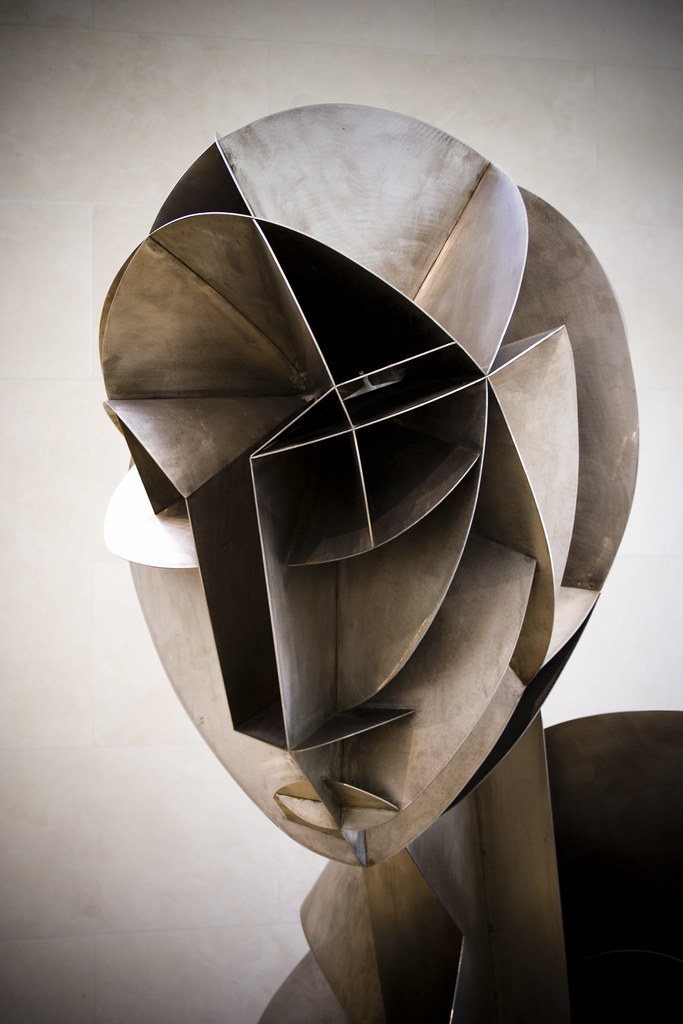
The Realistic Manifest, 1920 by Naum Gabo


Inventor of Kinetic Art.


The Realistic Manifesto, 1920 

"The text of this peace, Realisticheskii manifest, was published in August 1920 in Moscow. An open-air exhibition of Gabo’s and Pevsner’s work was organized simultaneously. […] ‘The Realistic Manifesto’ was to consolidate various ideas that had been supported by the Russian avant-garde long before 1920, rather than to advance totally new ones; furthermore, the manifesto itself exerted little influence on the actual development of Russian constructivism or of Russian art in general and had much more significance in the context of Western constructivism.”

[Excerpt from John E. Bowlt, Russian Art of the Avant-Garde]


“One had to examine Futurism beneath its appearance to realize that one faced a very ordinary chatterer, a very agile and prevaricating guy, clad in tatters of worn-out words like ‘patriotism’, ‘militarism,’ ‘contempt for the female,’  and all the rest of such provincial stages."

“Look at that ray of sun… the stillest of the still forces, it speeds more than 2000 kilometres in a second… behold our starry firmament… who hears it… and yet what are our depots to those depots of the Universe? What are our earthly trains to those hurrying trains of the galaxies?” 

“Indeed, the whole Futurist noise about speed is too obvious an anecdote, and from the moment that Futurism proclaimed that ‘Space and Time are yesterday’s dead,’ it sunk into obscurity and abstractions.” 

“But Life does not wait and the growth of generations does not stop and we go to relative those who have passed into history, having in our hands the results of their experiments, with their mistakes and their achievements, after years of experience equal to centuries… we say…
No new artistic system will withstand the pressure of a growing culture until the very foundation of Art will be erected on the real laws of Life.
Until all artists will say with us…
All is fiction… only life and its laws are authentic and in life only the active is beautiful and wise and strong and right, for life does not know beauty as an aesthetic measure… efficacious existence is the highest beauty.” 

“Life does not know rationally abstracted truths as a measure of cognizance, deed is the highest and surest of truths.”

“States, political and economic systems perish, ideas crumble, under the strains of ages… but life is strong and grows and time goes on in its real continuity.” 

“We know that everything has its own essential image; chair, table lamp, telephone, book, house, man… they are all entire worlds with their own rhythms, their own orbits.
That is why we in creating things take away from them the labels of their owners… all accidental and local, leaving only the reality of the constant rhythm of the forces in them.”
 
“Thence in painting we renounce colour as a pictorial element, colour is the idealized optical surface of objects; an exterior and superficial impression of them; colour is accidental and has nothing in common with the innermost essence of a thing.” 

"We affirm that the tone of a substance, i.e. it’s light-absorbing material body is its only pictorial reality.” 

“We renounce volume as a pictorial and plastic form of space; one cannot measure space in volumes as one cannot measure liquid in yards: look at our space… what is it if not one continuous depth?”

Space = continuous depth 

“We affirm in these arts a new element the kinetic rhythms as the basic forms of our perception of real time. “

“Today we proclaim our words to you people. in the squares and on the streets awe are placing our work convinced that art must not remain a sanctuary for the idle, a consolation for the wary, and a justification for the lazy. Art should attend us everywhere that life flows and acts… at the bench, at the table, at work, at rest, at play; on working days and holidays… at home and on the road… in order that the flame to live should not extinguish in mankind.
We do not look for justification, neither in the past nor in the future.
Nobody can tell us what the future is and what utensils does one eat it with.
Not to lie about the future is impossible and one can lie about it at will.
We assert that the shouts about the future are for us the same as the tears about the past: a renovated day-dream of the romantics.
A monkish delirium of the heavenly kingdom of the old attired in contemporary clothes.
He who is busy today with the morrow is busy doing nothing.
And he who tomorrow will bring us nothing of what he has done today is of no use for the future.
Today is the deed.
We will account for it tomorrow.
The past we are leaving behind as carrion.
The future we leave to the fortune-tellers.
We take the present day.”

--
Publishing Information: 
Russian Art of the Avant Garde Theory and Criticism Revised and Enlarged Edition edited by John E. Bowlt 

Tuesday, March 15, 2016

Cubism by David Burliuk, 1912


"These definitions in themselves show that everyone, even the  most Ignorant and those with no interest in the Spiritual, perceives the eternal gulf that has arisen between the painting of yesterday and the painting of today. An eternal gulf. Yesterday we did not have art."

“The fat bourgeois have shifted their shameful attention from the artist, and now this magician and sorcerer has the chance of escaping to the transcendental secrets of his art.”

“The component elements into which the essential nature of painting can be broken down are:
           I.                    Line
          II.                  Surface
         III.                Color
         IV.                Texture

To a certain extent Elements I and II were properties, peculiarities of old painting as well. But I and IV are those fabulous realms that only our twentieth century has discovered and whose painterly significance Nature has revealed to us. Previously painting only Sa, now it Feels. Previously it depicted an object in two dimensions, now wider possibilities have been disclosed… I am not talking about what the near future will bring us (this has already been discovered by such artists as P. P. Konchalovsky)- a Sense of Visual ponderability- A Sense of color Smell. A sense of duration of the colored moment… (I. I. Mashkov).” 

“The man deprived of a Painterly understanding of Nature will, when looking at Cezanne’s landscape the House, understand it puerely narritavely: (I) “house” (2) mountains (3) trees (4) sky. Whereas for the artist, there existed I linear construction II surface construction (not fully realized) and III color orchestration. For the artist, there were certain lines going up and down, right and left, but there wasn’t a house or trees… there were areas of certain color strength, of certain character. And that’s all.” 

An artist’s experience painting.

“Painting of the past, too, seemed at times to be not far from conceiving Nature as Line (of a certain character and of certain intensity) and colors (Nature as a number of colored areas- this applies Only to the Impressionists at the end of the ninetheenth century). But it never made up its mind to analyze visual Nature from the viewpoint of the essence of its surface. The conception of what we see as merely a number of certain definite sections of different surface Planes arose only in the twentieth century under the name of Cubism. Like everything else, Cubism has its history. Briefly, we can indicate the sources of this remarkable movement.”

“A few years ago artists wouldn’t have forgiven themselves if they’d talked about the aims, tasks, and essence of Painting. Times have changed. Nowadays not to be a theoretician of painting means to reject an understanding of it.”

“It has been known for a long time that what is important is not the what, but the how, i.e., which principles, which objectives, guided the artist’s creation of this or that work! it is essential to establish on the basis of which canon it (the work) arose! It is essential to reveal its painterly nature! It must be indicated what the aim in Nature was that the artist of the given picture was So attracted by. And the analysis of painterly phenomena will then be a Scientific criticism of the subject.”

“Disharmony is the opposite of harmony.
Dissymmetry is the opposite of symmetry.
Deconstruction is the opposite of construction.
A canon can be constructive.
A canon can be deconstructive.
Construction can be shifted or displaced
The canon of displaced construction.

“The existence in Nature of visual poetry- ancient, dilapidated towers and walls- points to the essential, tangible, and forceful supremacy of this kind of beauty.”
----------------------------------------------------------------------------------------------------------------------


David Burliuk seemed to have had a great personality. His energy is one of the most inspiring out of the Russian Avant-garde movement.


--

Publishing Information: 
Russian Art of the Avant Garde Theory and Criticism Revised and Enlarged Edition edited by John E. Bowlt